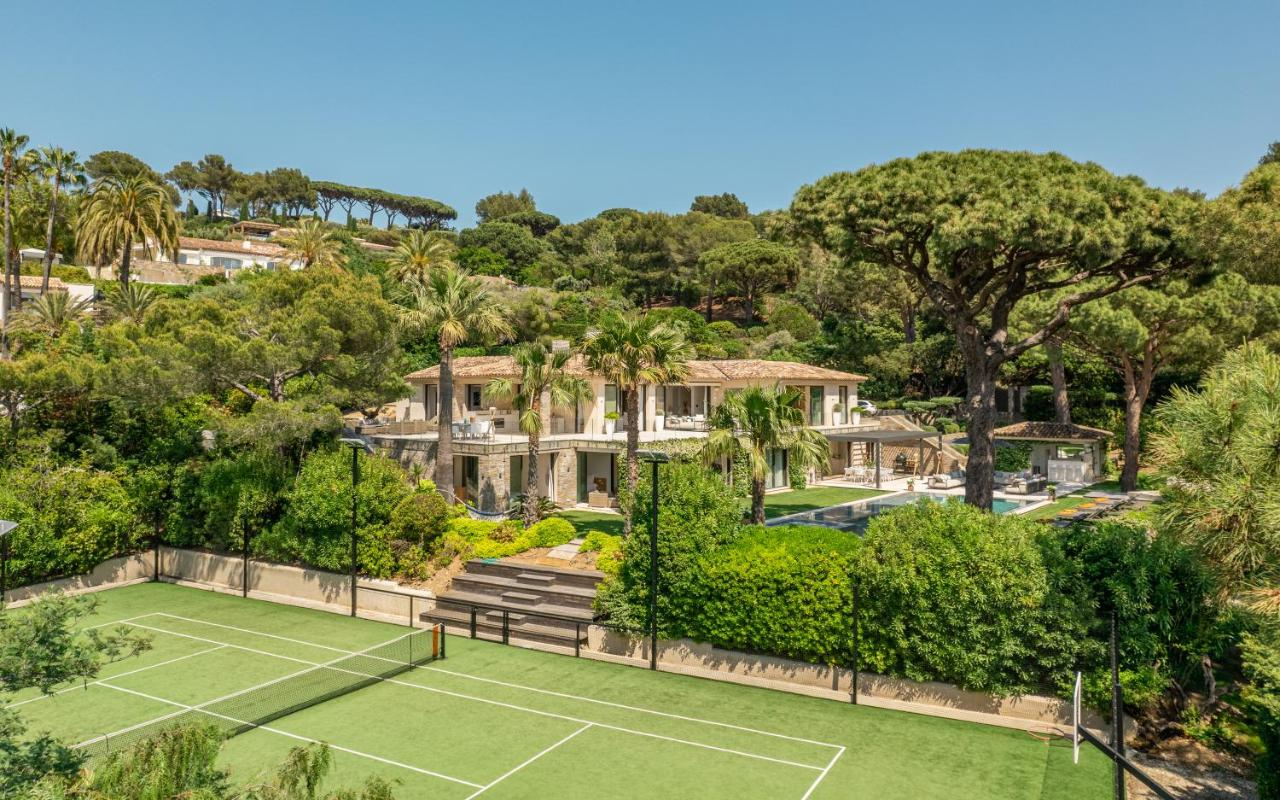
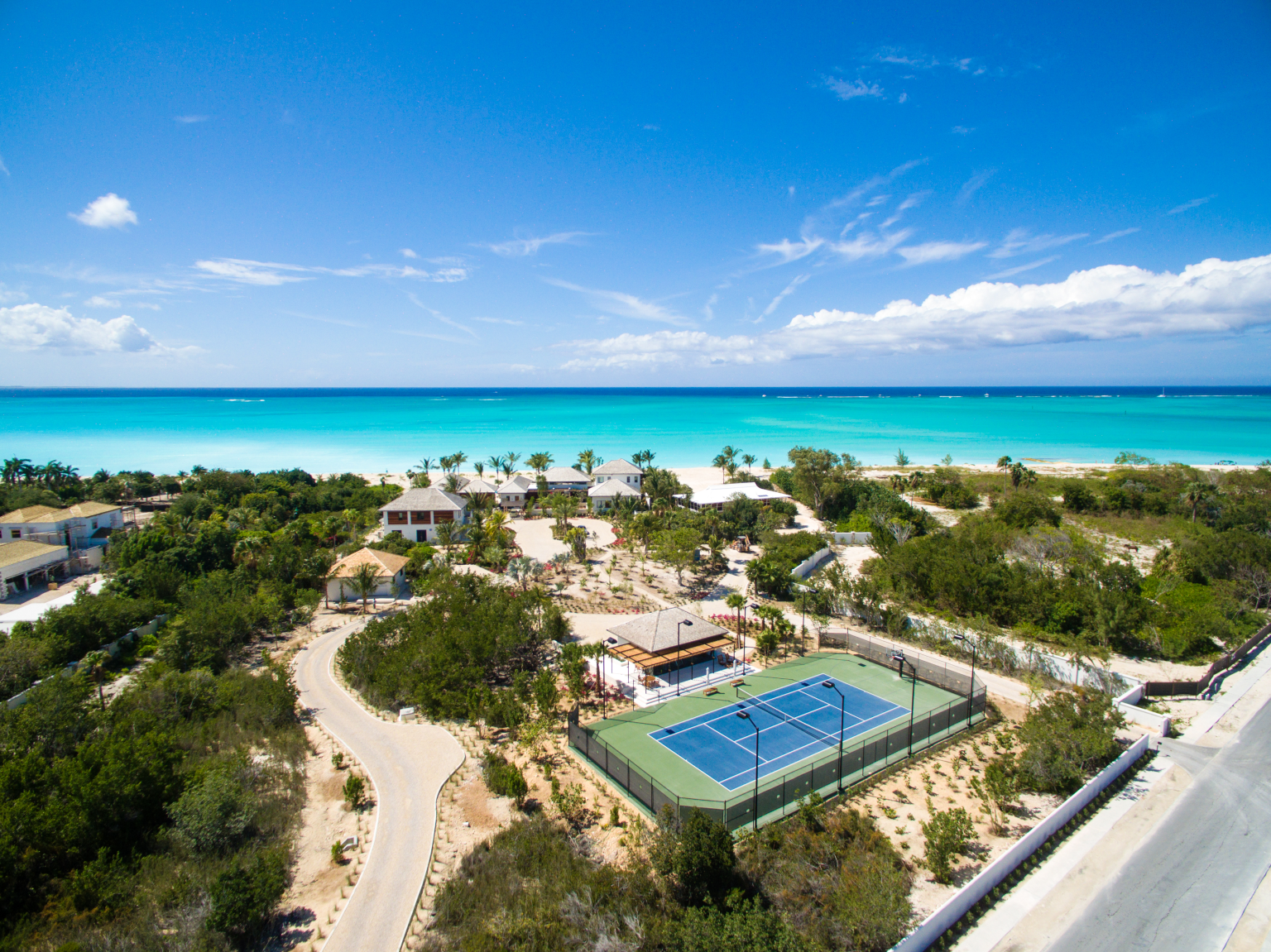
The Tennis Home Capitals of the United States
Where private tennis courts gather in the United States: the Hamptons, the Westside of Los Angeles and Pinecrest in Miami-Dade, seen from above, with the climate, the clubs and the homes in each.


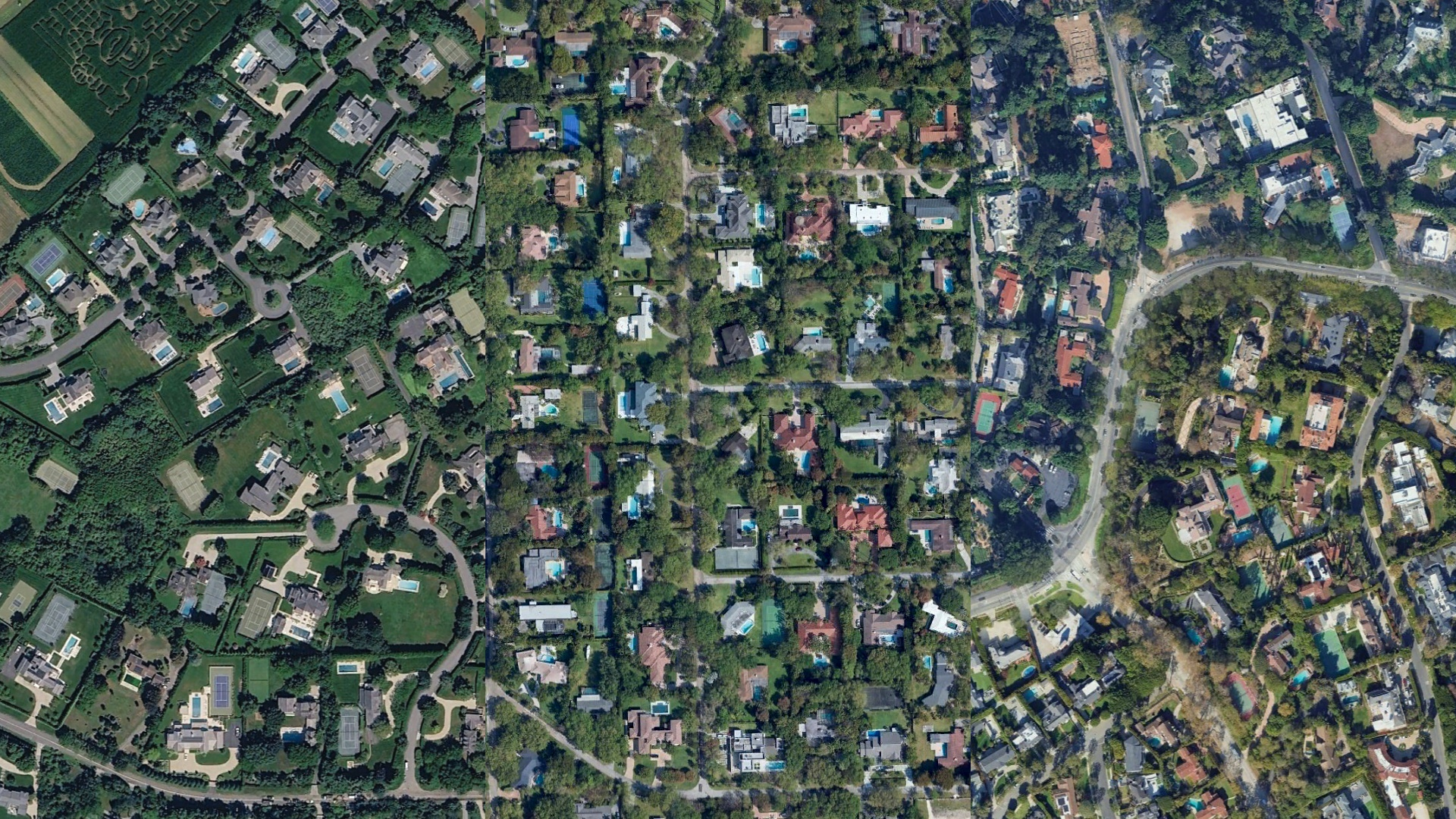
Where private tennis courts gather in the United States: the Hamptons, the Westside of Los Angeles and Pinecrest in Miami-Dade, seen from above, with the climate, the clubs and the homes in each.
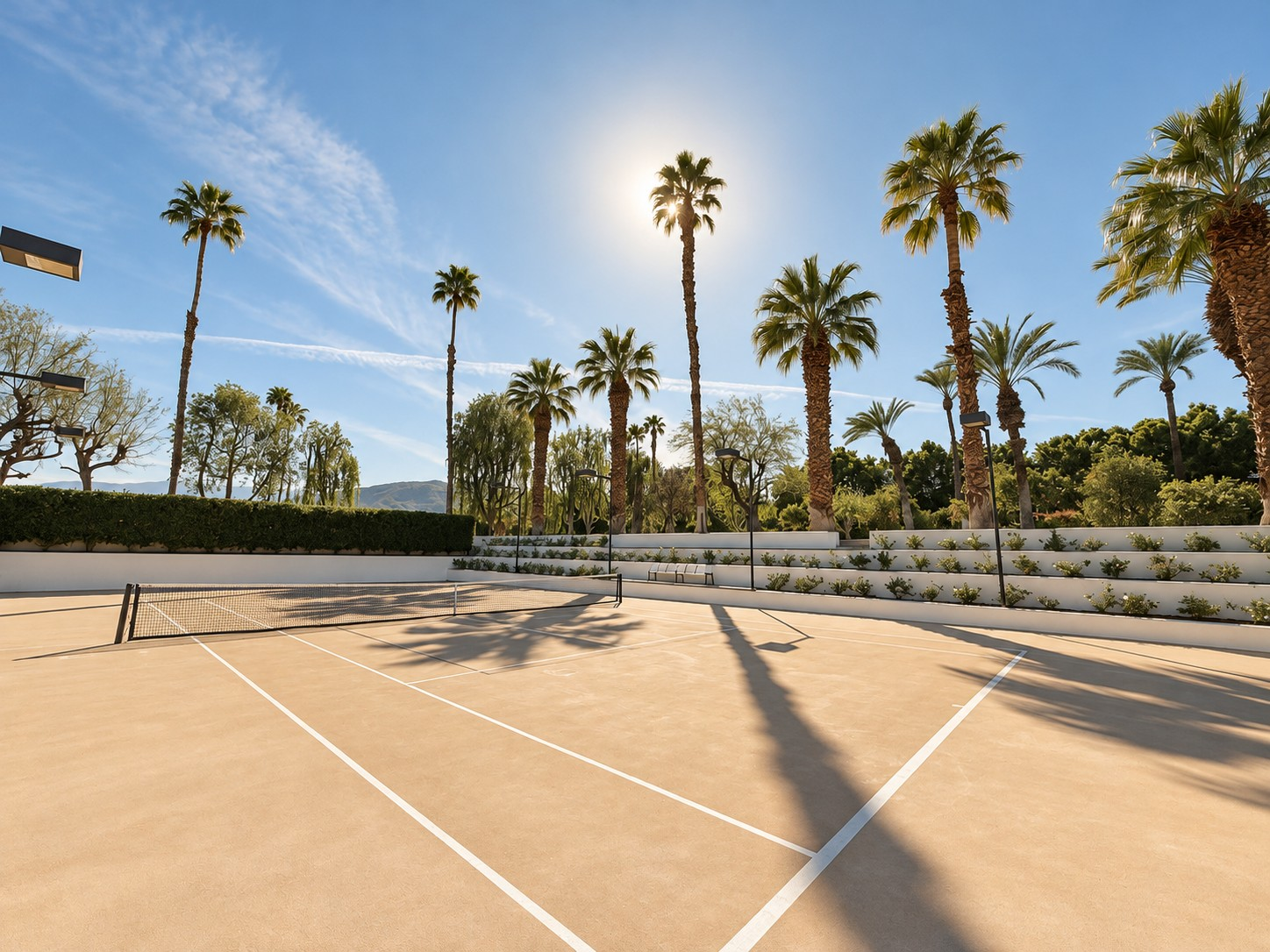
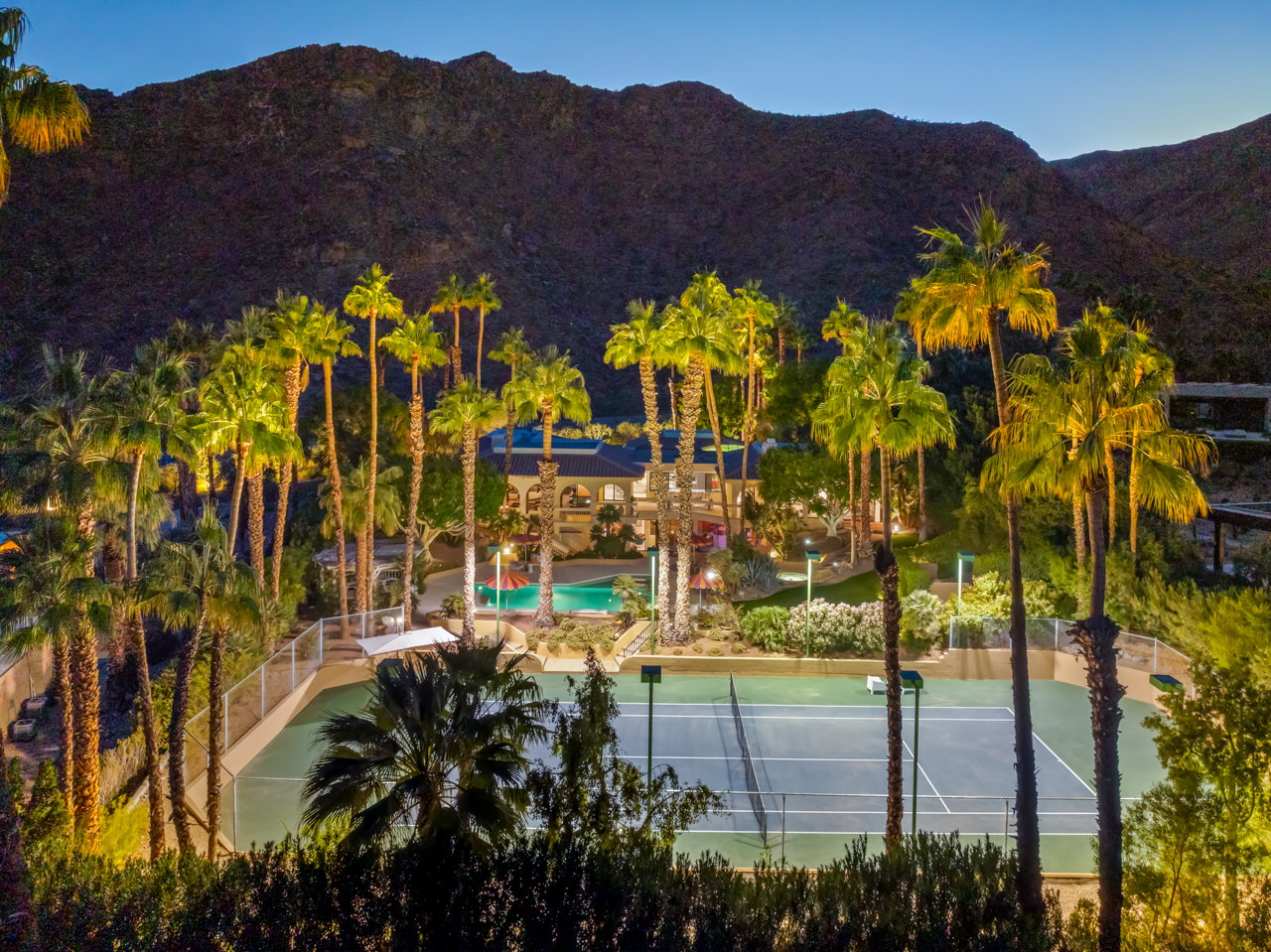
In Rancho Mirage a private tennis court must sit four feet below the garden. Four desert homes with tennis courts, and the city codes that shape them.
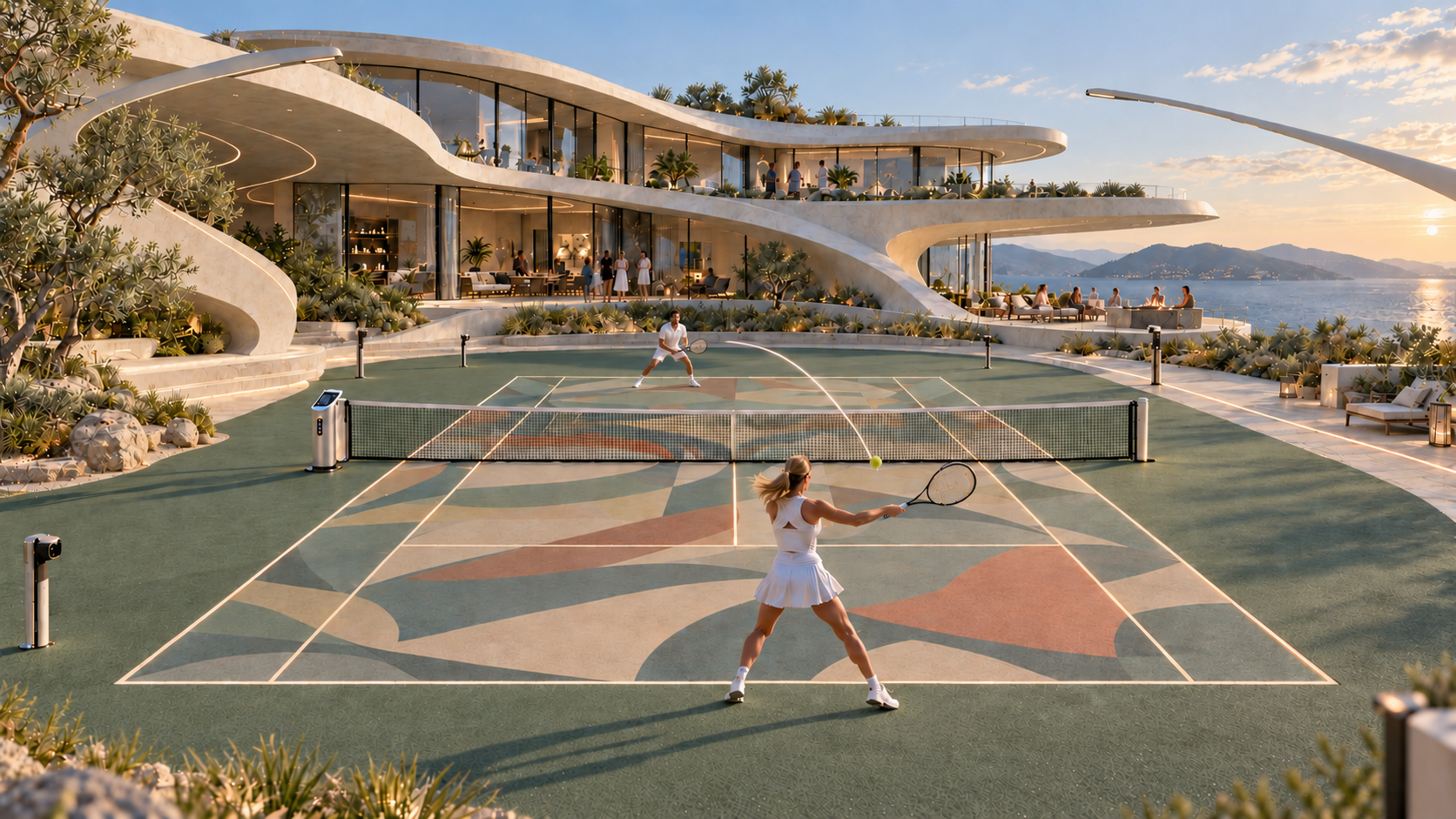
A year ago we predicted the tennis court would change slowly. It is learning to see, to coach and to play back. What would you teach yours next?
An estate earns the word historic through its architecture, its age and the people who lived there. The tennis court can tell a different story entirely, and three estates in our selection show how far apart the two can sit.
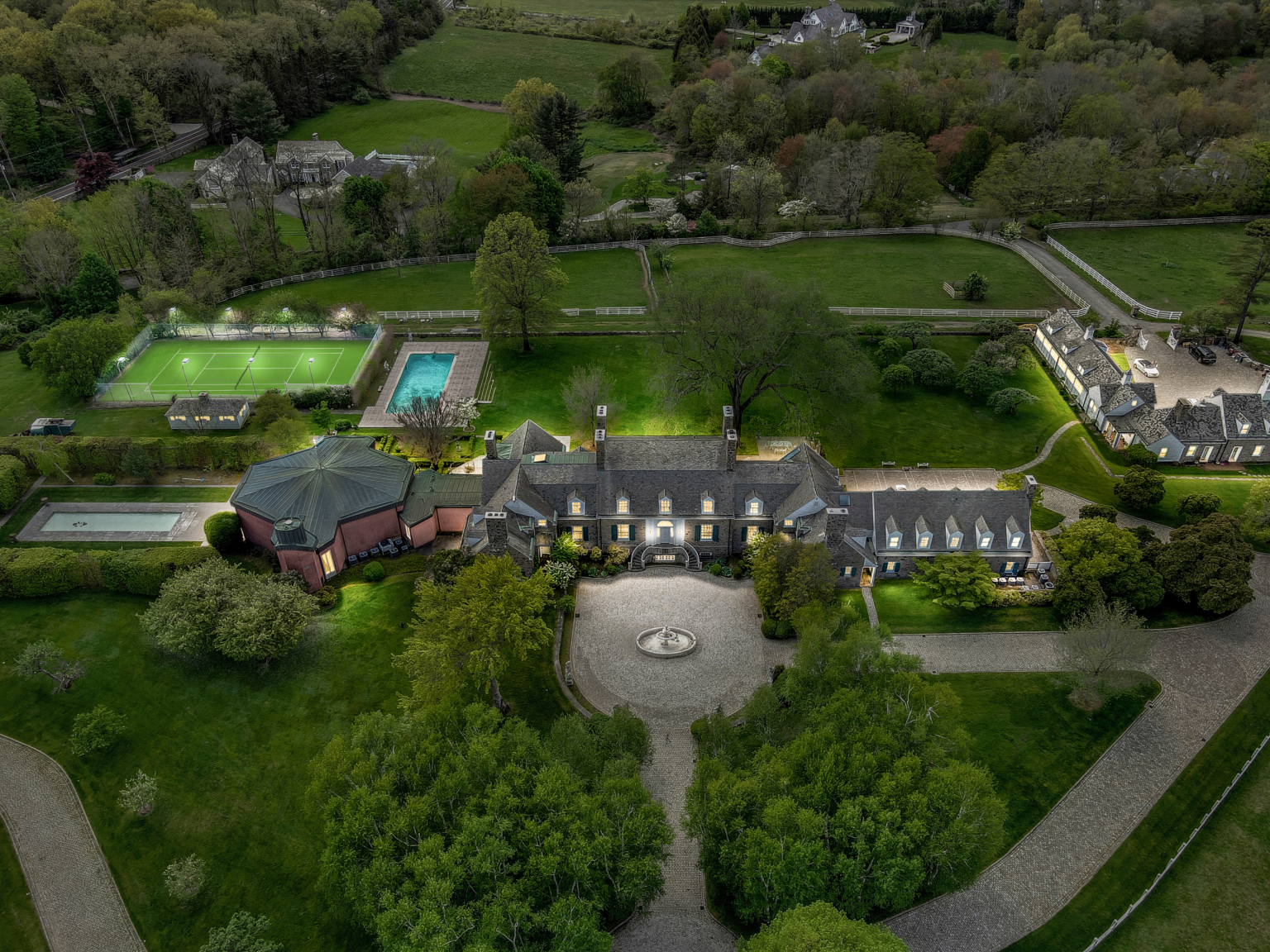
In East Hampton, the West End Road Compound is a Shingle Style estate from the 1890s; its red clay court was added only in recent years. In Beverly Hills, James Cagney built his home around 1939, and the tennis court was added later by the current owner. At the Hitchcock Estate in Millbrook, New York, the story runs the other way. The estate once had a clay court on its front lawn, until the fields crept over it, and by 1981 only the tennis pavilion remained.
So with any historic estate, ask when the court was built, and by whom. The answer tells you whether it belongs to the original story or to a later chapter, and sometimes whether it is waiting to be restored.
A Shingle Style estate on Georgica Pond, designed in the 1890s by J. Greenleaf Thorp, the architect of Grey Gardens. Its tower was added in 1899, and a boathouse sits on the pond. Read Red Clay on the Dunes.
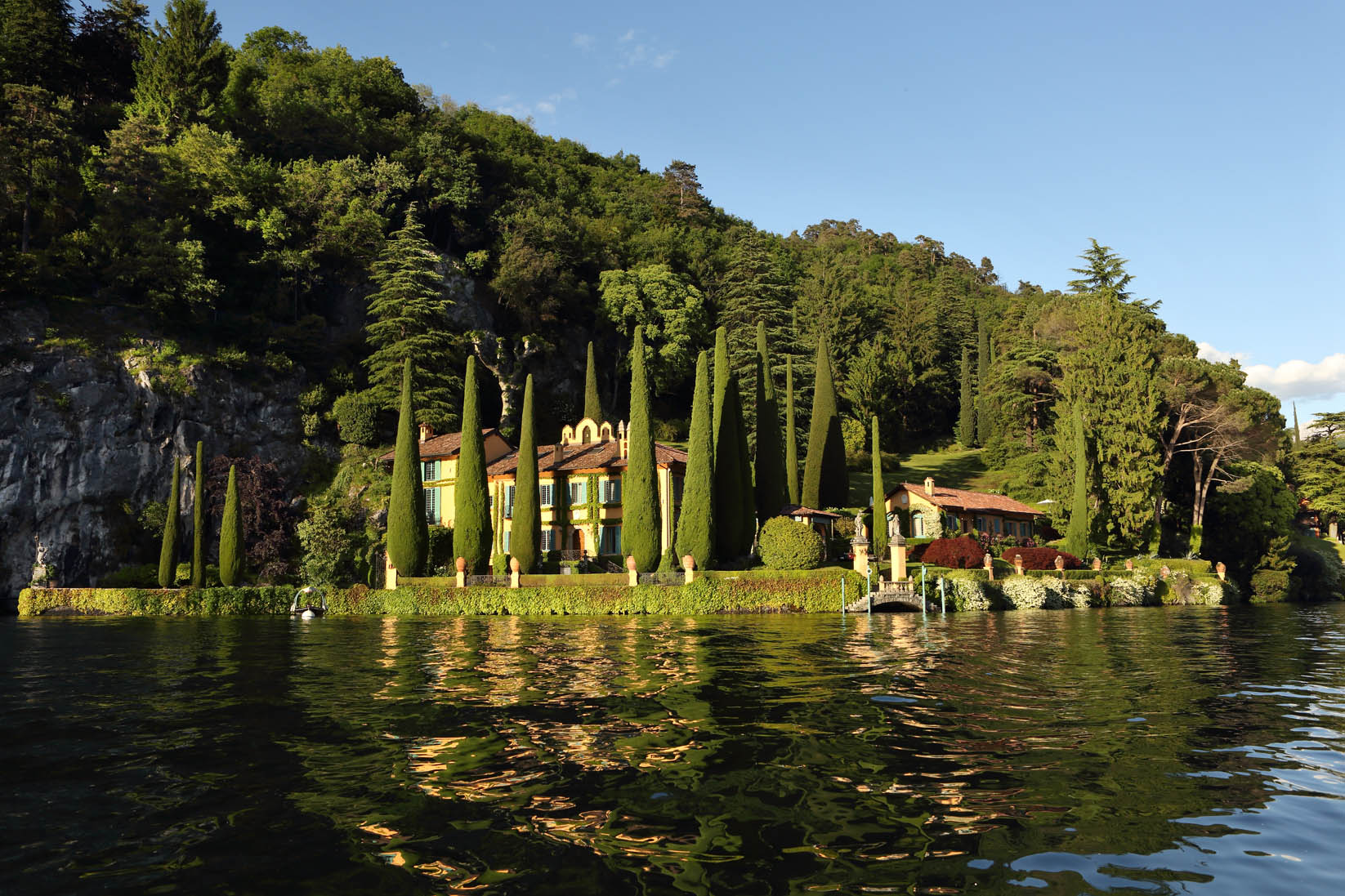
A lakefront estate of about three hectares near Lenno, with a heated infinity pool, a gym and a cinema room. Gianni Agnelli, La Provincia di Como reports, once pressed to buy it.
A Gilded Age estate in Dutchess County named Daheim, German for "at home", with a guest bungalow designed by Addison Mizner in 1912. The original clay court sat on the front lawn. Its pavilion survives, and in the 1960s it was known as the meditation house. When a court is worth saving.
Represented by Heather Croner, William Pitt SIR
A landmarked Addison Mizner estate in Palm Beach's Estate Section, one of only two Venetian-style residences he built in town. It sits on nearly 1.5 acres with 200 feet of frontage on the Intracoastal, and a multi-year restoration has just been completed, down to the tennis pavilion and the sunken red clay court.
An eighteenth-century Baroque manor in northern Portugal, reworked in the early twentieth century with neo-Victorian details. It is classified as a Monument of Public Interest, and its 3.6 hectares hold an indoor and an outdoor pool alongside the court.
A stone residence from around 1939 on just over five acres, with a guest house, a pool and the studio where Cagney painted. Architectural Digest featured the estate in 1990. Why that lighting matters.
Represented by Timothy Di Prizito, Christie's International Real Estate View property
For the longer history, read The History of the Private Tennis Court, and for more estates, The Art of Living Well: Historic Tennis Homes. If you own a historic home with a court, or are searching for one, we would like to hear from you.
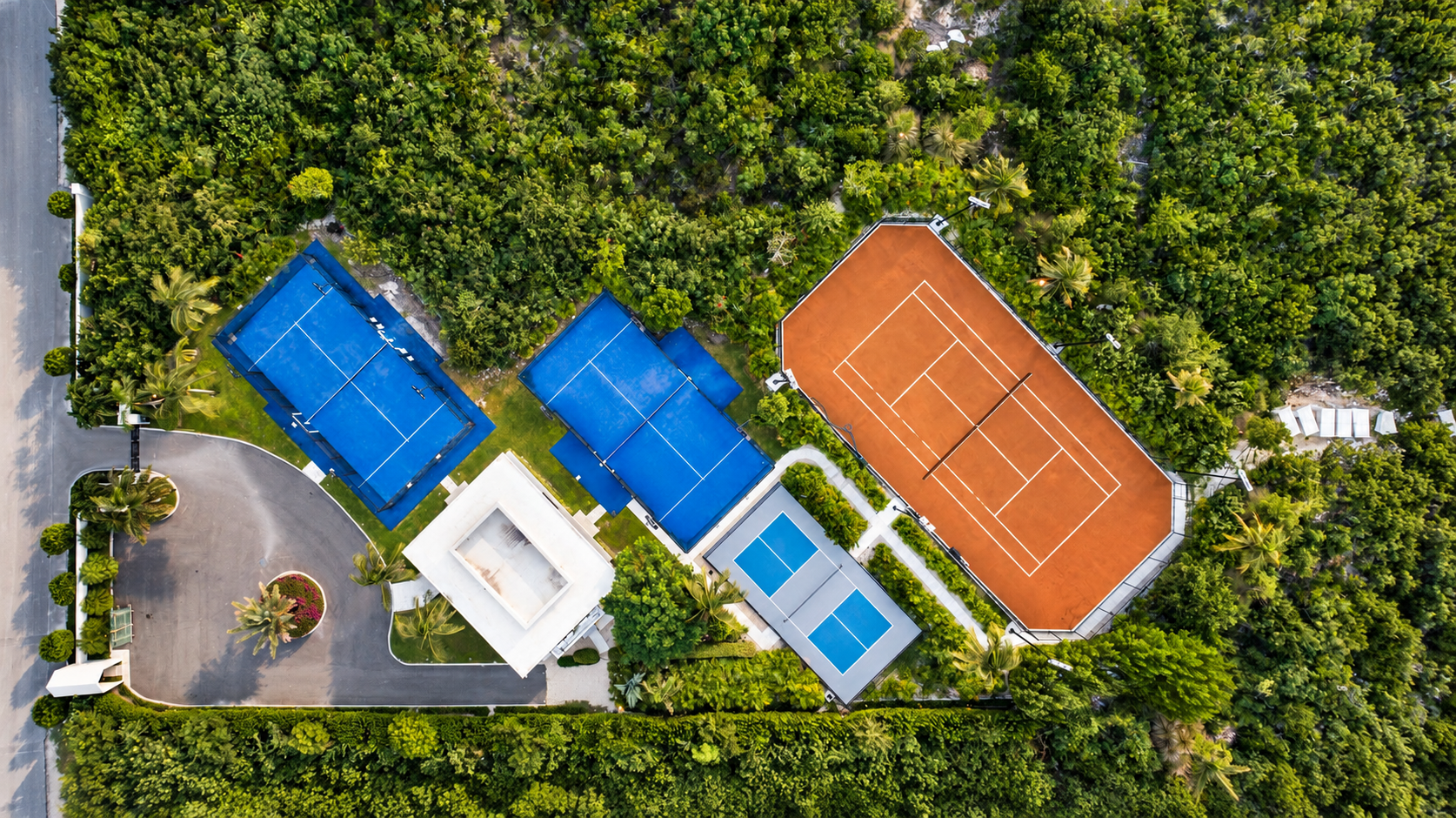
Cover Feature: Triton Villa | Ian Hurdle, The Agency
In 1969, at Las Brisas in Acapulco, Enrique Corcuera wanted a tennis court at his house and did not have the room for one. So he built something else. Twenty meters by ten, walled to three meters, with a tennis net strung across the middle. His wife Viviana wrote the first set of rules and gave them to him as a birthday present. That court, in that garden, is where padel begins.
It did not stay in the garden. Prince Alfonso of Hohenlohe visited the house, saw the court and built his own at the Marbella Club Hotel in the early seventies. Julio Menditeguy, an Argentine member of Alfonso's club, carried the game to Buenos Aires, where the first courts went up at Club Tortugas and the Mar del Plata Ocean Club. Argentina formed the world's first national association in 1988. The international federation followed in Madrid in 1991, and the first world championships a year later. Today the FIP counts a hundred affiliated federations, play in more than 150 countries and something like 35 million amateur players.
All of which makes the way padel is usually described slightly backwards. The sport gets written about as though it were arriving in private homes, a club game finally making its way up the drive. It is not arriving. It is coming back.
About 2.5% of the homes we represent have both a tennis court and a padel court.
| Property | Country | Tennis | Padel | Also on the property | Available for |
|---|---|---|---|---|---|
| Villa Mera | Morocco | Clay | Yes | Pétanque field | Rent |
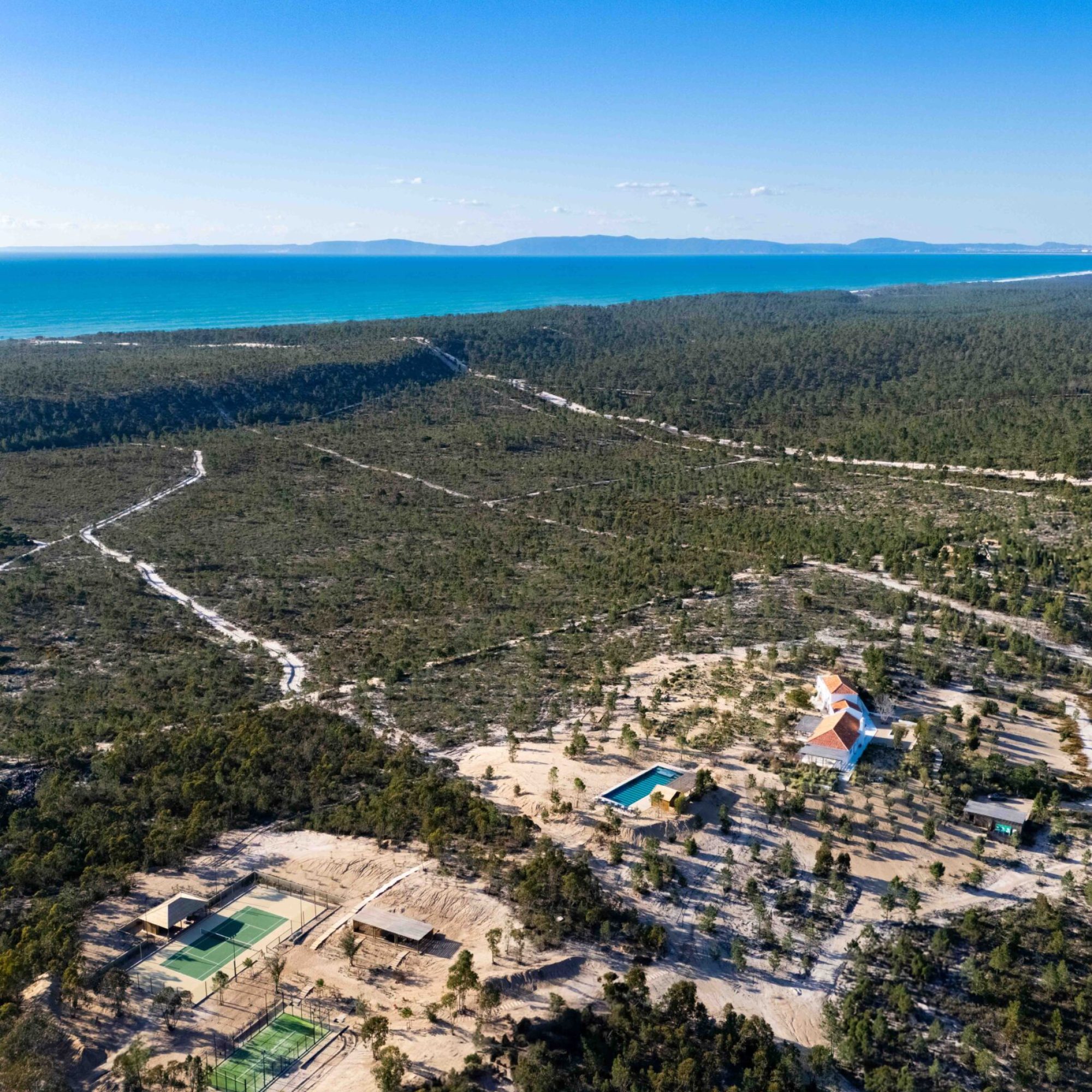
| Villa Maré | Portugal | Hard | Yes | Private beach access, heated pool, cinema room | Rent |
| The Grove Estate | Estonia | Synthetic turf | Yes | Sauna house, indoor pool, river through the grounds | Rent |
| Triton Villa | Turks and Caicos | Clay and hard | Two courts | Pickleball court | Sale and rent |
There is something quietly good about a property that has both. Corcuera built his court because the tennis court was impossible. On these four estates both are possible, and they sit within a short walk of each other, the constraint that created the sport and the sport it created sharing one garden.
Padel has barely moved since Acapulco. The International Padel Federation still fixes the court at twenty meters by ten, with the walls, the mesh, and a surface of cement, synthetic material or artificial grass. The dimensions of a game played in more than 150 countries are, more or less, the dimensions of one man's back garden. Every padel court in our collection is laid on artificial grass, which is why they feel familiar wherever you find them.
The tennis courts on the same four properties have nothing in common. Clay in Morocco, hard in Portugal, synthetic turf in Estonia, and at Triton Villa one of each, clay and hard. Tennis never standardized the ground it is played on, and that difference is not cosmetic. It is the one thing worth asking about before you travel, and it is worth knowing what each surface asks of you before you choose between them.
Two courts a short walk apart, and two completely different journeys to get there. Worth seeing in person.
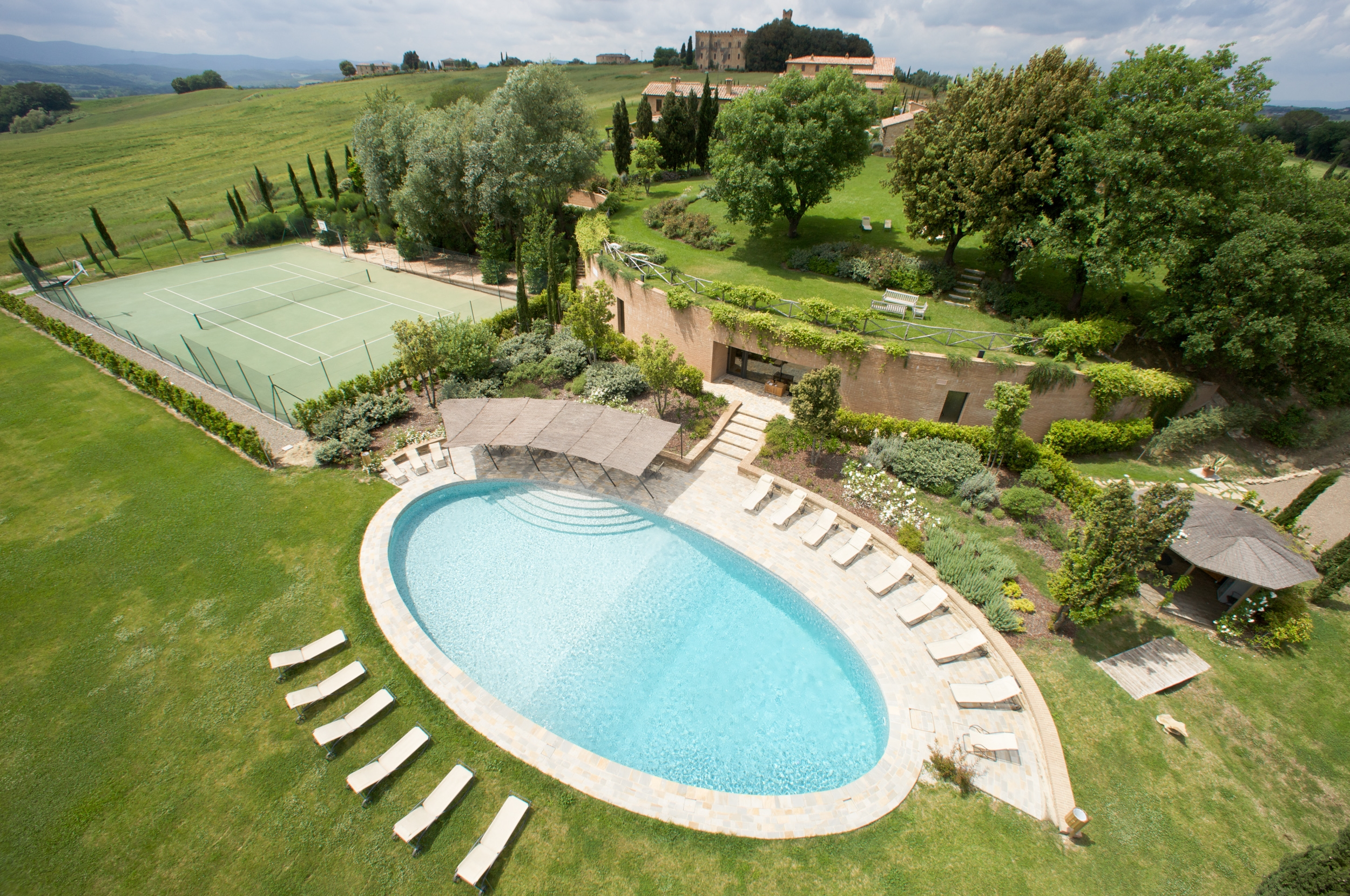
Cover Feature: Tenuta La Serenata | The Luxury Travel Book
Every private court has good hours. The useful question is where they fall in the month you are going, and what the house can do to give you more of them.
Some of the best tennis we see happens in the middle of August, at seven in the morning and again at seven at night, in places where nobody would play at two. And some of the easiest happens in October, when the same court runs all day and the house is quiet.
Both are good weeks. They just ask different things of the property. Across the villas with private tennis courts we rent, the gap between a long playing day and a short one comes down to three things, and all of them are easy to check before you book.
This part is not a matter of opinion.
A 2024 study published in Scientific Reports measured heat across tennis court surfaces through a full summer. Hard courts came out hottest, sand-filled artificial grass close behind, clay measurably cooler. The recommendation was direct: play less in the early afternoon, and move the game to the morning, the evening, or under lights. The ITF's surface selection guidance says the same from the construction side, that climate should decide the surface before anything else does.
So in high summer, clay buys you the longest afternoon and an unshaded hard court the shortest. In spring and autumn it barely matters. Same court, different month, different question.
Country by country, when the day runs longest and what to ask for when you are going outside that window.
| Country | Longest playing days | Ask for |
|---|---|---|
| France | May, June, September, October | The coast holds the summer afternoon better than the interior. Inland, ask for lights |
| Italy | June and September | Elevation. The hills and lakes hold the afternoon far longer than the coast |
| Morocco | March, April, October, November | Clay and lights. Both are common here, and together they cover the summer |
| Spain | May, June, September, October | Shelter around the court. Island courts are often the most exposed part of the property |
| Portugal | April to June, September, October | Little. Summers here are milder than most people expect |
| Greece | May, June, September, October | Shade near the court, and lights on the hotter islands |
| Turks and Caicos | December to April | Every court here is lit, so ask about the sport instead. Padel and pickleball sit alongside tennis |
| St Barths | December to April | Lighting is a given. If you are travelling in autumn, ask about the hurricane calendar |
| US Virgin Islands | December to April | Lit as standard. The driest, steadiest weeks are late winter |
| Thailand | February to April | Also lit throughout, so the month matters more than the court. Rain is what moves here, not heat |
Three of those deserve a sentence more.
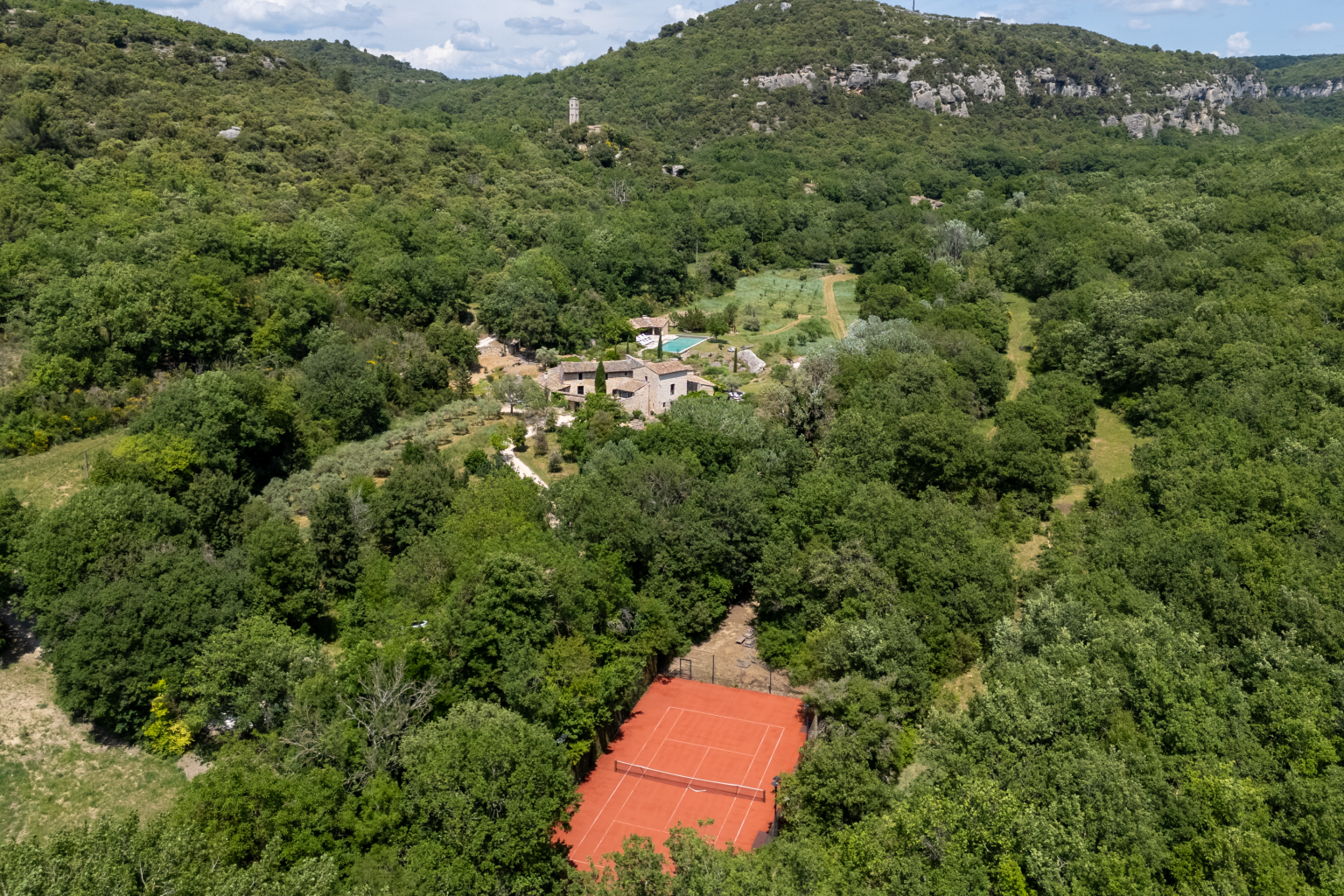
France is the one that surprises people. The Riviera coast stays moderate right through the summer, while an hour inland is a properly hot July. Provence in August is excellent tennis at either end of the day, which is why a lit court there is worth asking for specifically.
The Caribbean runs on a different calendar entirely. The Atlantic hurricane season runs June to the end of November, and the long dry stretch is the northern winter. It is also the only place we work where playing after dark is simply how the court gets used. The day divides at nine in the morning and eight at night, and the middle belongs to the water.
Thailand catches people out because Koh Samui sits on the wrong side of the country for the southwest monsoon, so its wet season arrives when the mainland's is ending. Late autumn is the wet stretch and late winter into spring is the dry one. Rain there tends to come hard and briefly rather than all day, so an hour's patience usually gets the game back.
Lights. The only feature that adds hours rather than moving them. A little over half the courts we rent are floodlit, and the pattern is worth knowing. Everything we hold in the Caribbean and Thailand has lights. In Morocco, every padel court is lit. In France, roughly half are, which is why it is the first thing we check on any property we take on. Lighting is stated inconsistently on most listing sites, so ask rather than assume.
Surface matched to the month. Clay for the heat, hard court for spring and autumn, and if the trip is a summer one, the combination of clay and lights is the longest playing day money can buy.
Somebody looking after the court. A court is a maintained surface, not a fixed feature, and how it is kept changes the week more than most things in a listing. Clay wants watering and brushing, and through a hot week it plays differently on Friday than it did on Monday depending on whether anyone has touched it. Hard courts want sweeping and a clean surface, particularly under trees. Some houses have this built into the service, with a groundsman who does the court alongside the garden or a local club that sends someone. Others arrange it when guests ask. Either way it is rarely spelled out, so the question worth asking is simply how the court is maintained and who does it. It tells you a great deal about how seriously the court is taken in that house.
Tell us your weeks and whether you intend to play every day. We hold surface, lighting and court detail on every home we rent, and it is frequently more accurate than what is published elsewhere. We will come back with two or three that fit the month, and what to expect from the court while you are there.
Know someone planning a court-led trip? Send this to them.
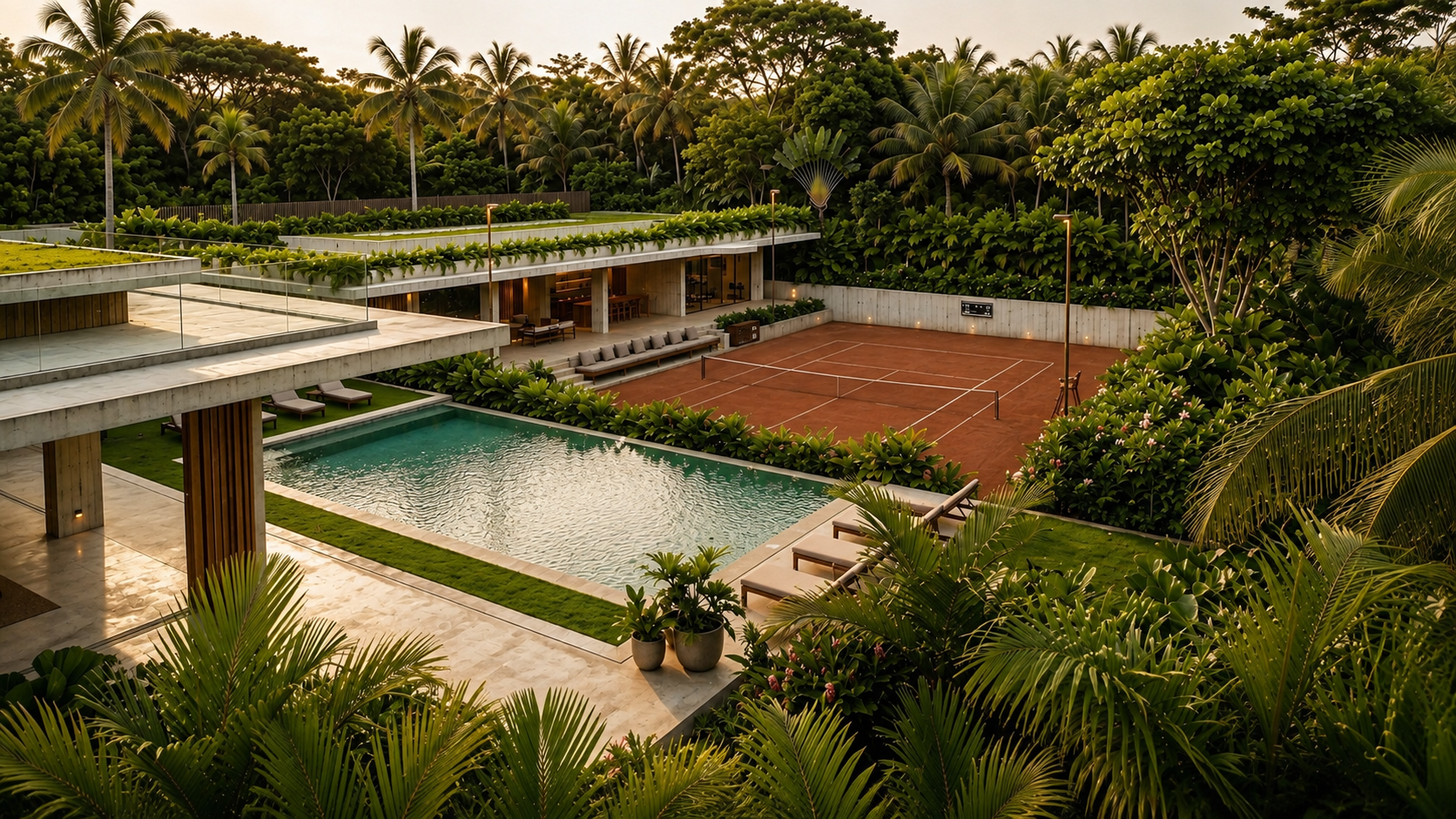
Cover Feature: Concept images generated with AI. Visual reference only. Not a real property and not a listing.
Spend enough time looking at homes built around tennis and you inevitably start borrowing ideas.
A sunken court from one. A pavilion from another. The relationship between a pool and a court somewhere else. Then there are the smaller details that rarely make the photographs: where the ball machine lives, how players get clay off their shoes, where a coach sits, or what happens between the end of a match and dinner.
So we decided to stitch them together.
Starting with a blank site, this is the tennis home we would build for ourselves. The real decisions would, of course, respond to the land, climate and local requirements. But for now, we get to imagine it from the ground up.
And we would start with the court.
Ours would be sunken into the landscape, set far enough from the house to feel like its own destination, but close enough that you could still see it from the spaces where you spend the day.
The sequence would be simple: house, pool, court.
From the house, the pool would sit in the foreground and the tennis court beyond it, slightly lower in the landscape. A clear path would connect the three.
We would choose a sunken court partly because we love the architectural effect, but there is a practical case for it too. Depending on the site, the surrounding grade, retaining walls and landscape can contribute to a more protected playing environment, particularly when wind is a concern.
It is not necessarily the right solution everywhere. Lowering a court changes how water moves through the site and introduces retaining structures, so drainage, soil conditions and engineering become part of the decision. On some properties, working with the natural grade may make far more sense.
For ours, the retaining structure could become courtside seating, softened with planting. We would keep the immediate surroundings controlled, using the landscape to frame the court without creating unnecessary debris on the clay.
Orientation would be resolved just as early. A north-south court is generally preferred, helping reduce the impact of low morning and evening sun in players' eyes. We would use that as the starting point, then adjust for the site's prevailing winds, topography and other conditions.
The court, in other words, would help organize the property from the beginning.
The surface would be an easy decision for us: a private clay court. We love how tennis is played on it, but just as importantly, we would want a surface that feels more forgiving on the body. The loose top dressing allows controlled sliding rather than the abrupt stops of a harder surface.
There is also something timeless about red clay. It carries the history of European tennis and immediately evokes the courts of continental Europe, particularly France, Spain and Italy. Surrounded by stone and planting, it can bring a little of that feeling to a tennis home almost anywhere in the world.
There is, however, a complication in combining our first two choices. A sunken court sits below some of the surrounding land, while a clay court depends on carefully controlled water. The court itself needs the correct construction and slight slope to manage water, while runoff from the higher ground around it needs to be intercepted and directed away. Retaining walls also need their own drainage. None of this makes a sunken clay court a bad idea, but it does make drainage and site engineering fundamental to getting it right.
Clay brings maintenance too. A traditional court requires regular watering, brushing and rolling, along with periodic repairs, line care and surface reconditioning. We would plan irrigation from the beginning and give the equipment needed to maintain the court a dedicated storage area nearby.
That maintenance would influence more than the court itself. Clay travels on shoes, equipment and players, so the transition from court to pavilion deserves almost as much thought as the playing surface.
If you want the technical groundwork, our guide to building a private tennis court covers the construction side in more detail.
Next to the court, we would build a pavilion that connects naturally back toward the pool. Not a clubhouse in miniature, but a place that makes everything around playing easier: somewhere to sit in the shade, watch a match, have lunch, train, recover and spend time without having to return to the main house.
We would include a covered seating and dining area with a BBQ, a bathroom and shower, and proper storage for rackets, balls, a ball machine and the equipment required to maintain the clay court. The gym would sit here too, ideally with a view onto the court, alongside a sauna and cold plunge. The pavilion itself would provide comfortable seating for anyone watching.
Clay would influence some of the less obvious decisions. At the transition from court to pavilion, we would install a proper clay-court shoe cleaner, either a brush system or one that uses water to clean the soles before players continue inside. We would also avoid very light flooring immediately around this area, choosing a durable stone or similarly practical surface that can live comfortably with the clay rather than constantly fighting it.
The position matters as much as what goes inside. We would want the pavilion close enough to the court to function during play, but oriented so that its shaded areas actually remain useful when we are most likely to play. It would also sit naturally on the route between court and pool, making the progression from a match to a swim, recovery session or lunch almost effortless.
The pavilion is where the tennis court stops being an isolated piece of sports infrastructure and becomes part of how the rest of the home is used.
The pavilion handles everything after a match. But between points, nobody wants to walk anywhere.
We would build covered seating directly on the court, at the net, the way it works at a club. A bench for each side rather than one shared, because changeovers are the only real rest in a set. Next to it, a small fridge for cold water, kept under cover since clay dust finds every vent. A rail for towels, out of the sun. All of it needs power at court level, which is one more reason to resolve the electrical plan before the court is built.
Then the umpire chair. It is a decision, not a default. A tall chair at the net makes a private court feel like a real venue and gives a coach the best sightline in the place. Some find it theatrical for a home. We would want one, positioned where it does not throw a shadow across the service boxes in late afternoon.
On the retaining wall, two displays. A digital scoreboard, because the traditional flip version is charming and nobody ever updates it. And a serve speed readout, which is not about matching anyone on tour. It is about watching a number move over a season, or handing a teenager something they will chase for an hour. Both share the same wall, the same power run and the same off switch, so the court goes quiet when nobody is playing.
None of these are expensive relative to the court itself. They are just the difference between a court you play on and a court you stay on.
Lighting would be part of the original court design, not something added later. A private court that works beautifully during the day but becomes unusable after sunset would feel like a missed opportunity.
The goal would not be to make it excessively bright. Brightness on its own means very little. What matters is how evenly the light falls across the playing area, whether the ball stays visible through the full arc of a shot, and what the fixtures do to a player looking up into them.
We would use sharp-cutoff fixtures that direct light where it is needed and limit spill beyond the court. That matters on any property, but particularly where the court sits close to gardens, the house or neighboring land. Pole height and position would follow the lighting design rather than the other way around, and we would want that design to come from someone who does this for a living.
There is also a more fundamental question: are lights allowed at all? Local zoning, planning rules, environmental restrictions and community regulations can limit or prohibit new court lighting. In some markets, existing lights survive only because they were installed before today's rules, which makes their grandfathered status worth understanding before you buy.
Where lighting is possible, we would plan the electrical infrastructure before the court was built. Conduit and underground wiring are much easier to resolve at construction than after the landscaping, retaining walls and clay court are finished.
The best result, to us, would be a court that feels properly lit when you are playing and surprisingly dark when you are standing anywhere else.
For all the history and tradition we associate with a red clay court, we would want the technology behind it to be very current. Ideally, most of it would barely be visible.
We would integrate cameras for recording matches and training sessions, with the possibility of adding player and ball tracking for deeper analysis. Systems already exist that can combine match footage with statistics and movement data, making this useful for much more than replaying a favorite point. We would plan the camera positions, power and connectivity as part of the court rather than attaching equipment later.
The clay itself could be smarter too. Subsurface irrigation systems can maintain moisture from below the court, while newer digital systems allow water levels to be monitored and adjusted remotely. For a surface that depends so heavily on consistent moisture, that is exactly the kind of technology we would want working quietly in the background.
We would take the same approach to lighting controls, power for training equipment and strong connectivity around the court and pavilion. More importantly, we would install enough conduit and accessible infrastructure to allow the technology to change over time without having to disturb the court or surrounding landscape.
The idea is simple: a court that looks timeless, but doesn't behave like it was built in the past.
We looked at where this is heading in The Tennis Homes of Tomorrow.
If tennis is important enough to shape the property, we would also make it easy to bring a coach into it.
Rather than adding accommodation to the pavilion, we would give the coach a place in a separate guest cottage. That creates enough independence for someone to stay for a few days or several weeks of training, while keeping the cottage useful for friends and family the rest of the year.
Courtside, we would keep things simpler: a proper coach's chair positioned with a clear view of play, shade nearby, water and easy access to the equipment stored in the pavilion. The idea is not to recreate an academy, but to make private coaching feel completely natural within the home.
That distinction matters. A tennis home should still feel like a home, even when it is capable of supporting serious training.
The same site could hold a different sport, and the decisions would mostly transfer.
A padel court is smaller and enclosed in glass, which changes how it sits in a landscape. Sunk into a slope, the glass reads as almost nothing from above, and the retaining wall becomes a natural viewing position. Lighting has to account for reflection off the glass, which is a different problem from lighting an open court. A pickleball court is smaller again, which frees up land and makes court position much more flexible on a tight site.
We would not overlay either onto the tennis court. Shared lines make every surface slightly worse than a dedicated one, and on clay the maintenance becomes harder rather than easier.
If we were building all three, we would invert the plan. The pavilion would move to the center, with the courts arranged around it. Same gear room, same shade, same recovery space, serving three surfaces instead of one. The pavilion stops being an attachment to a court and becomes the center of the property.
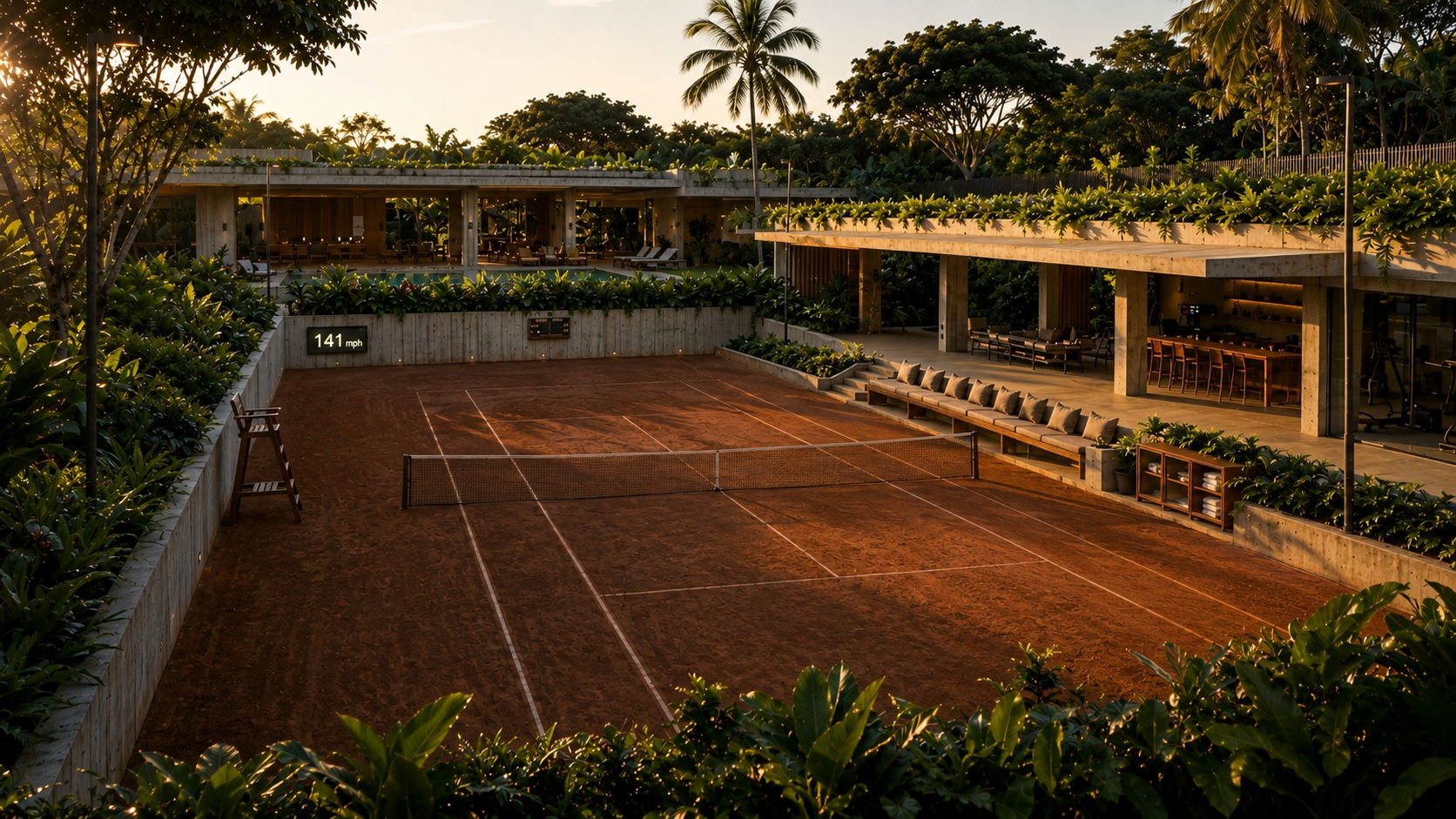
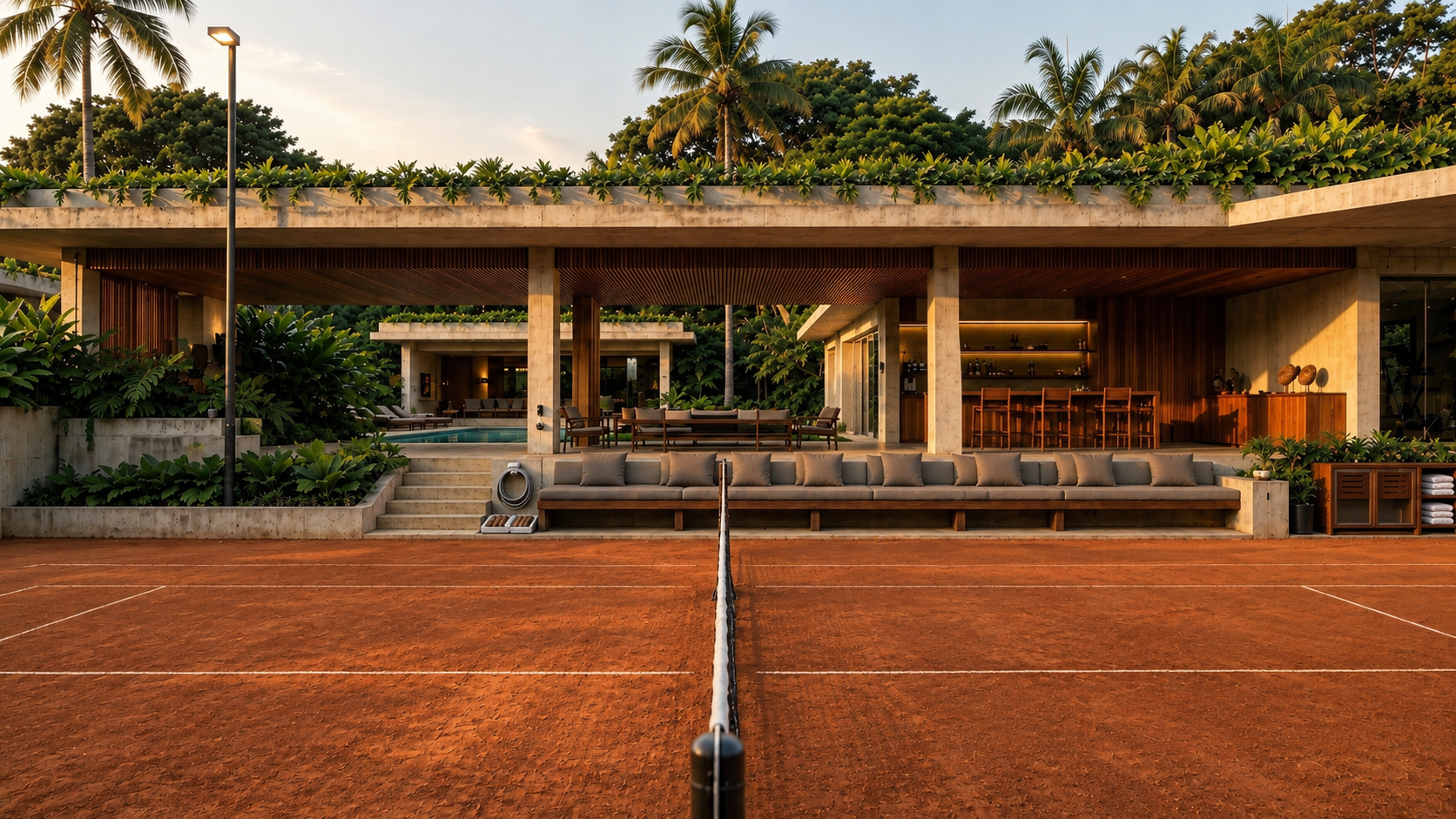
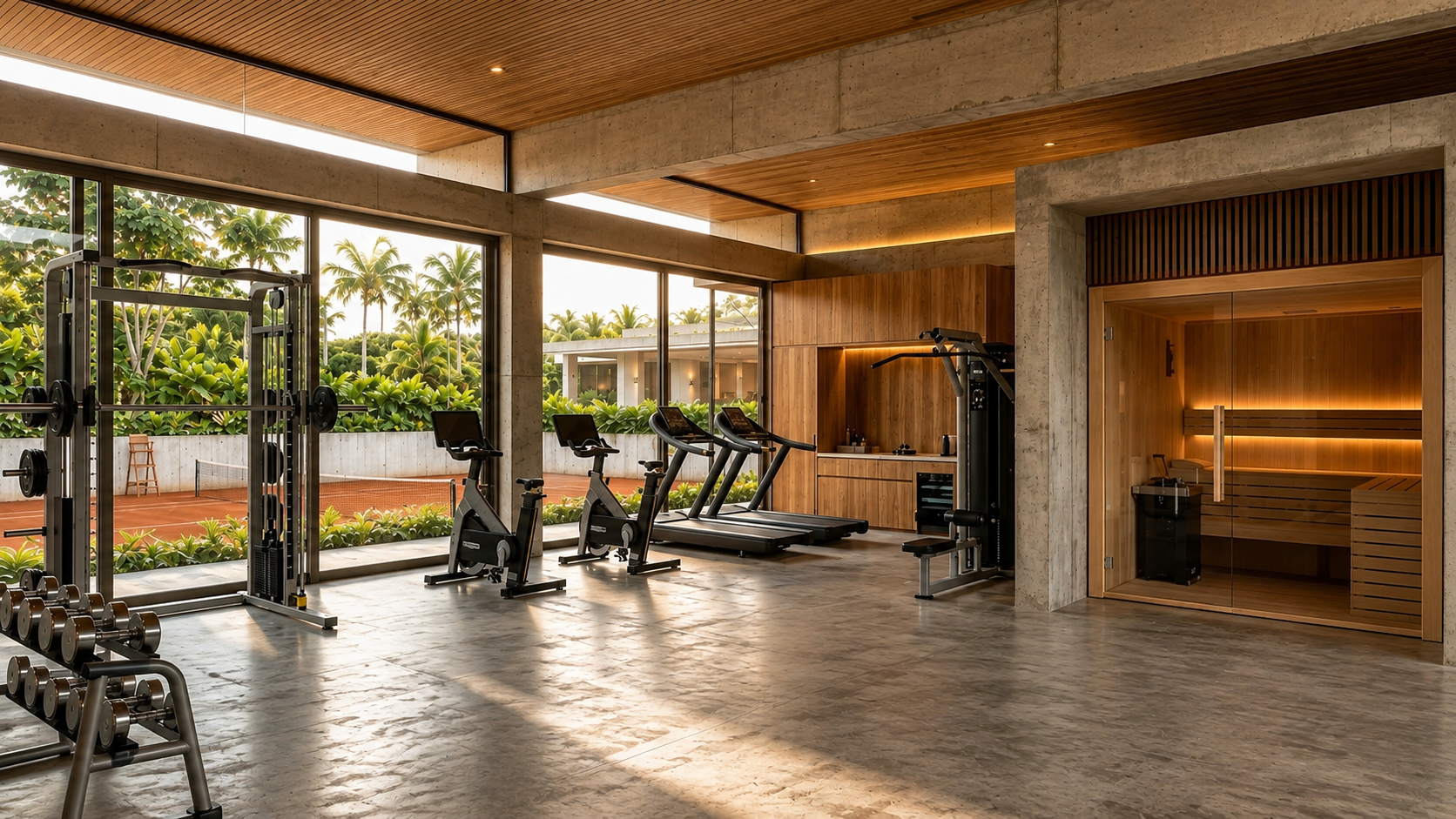
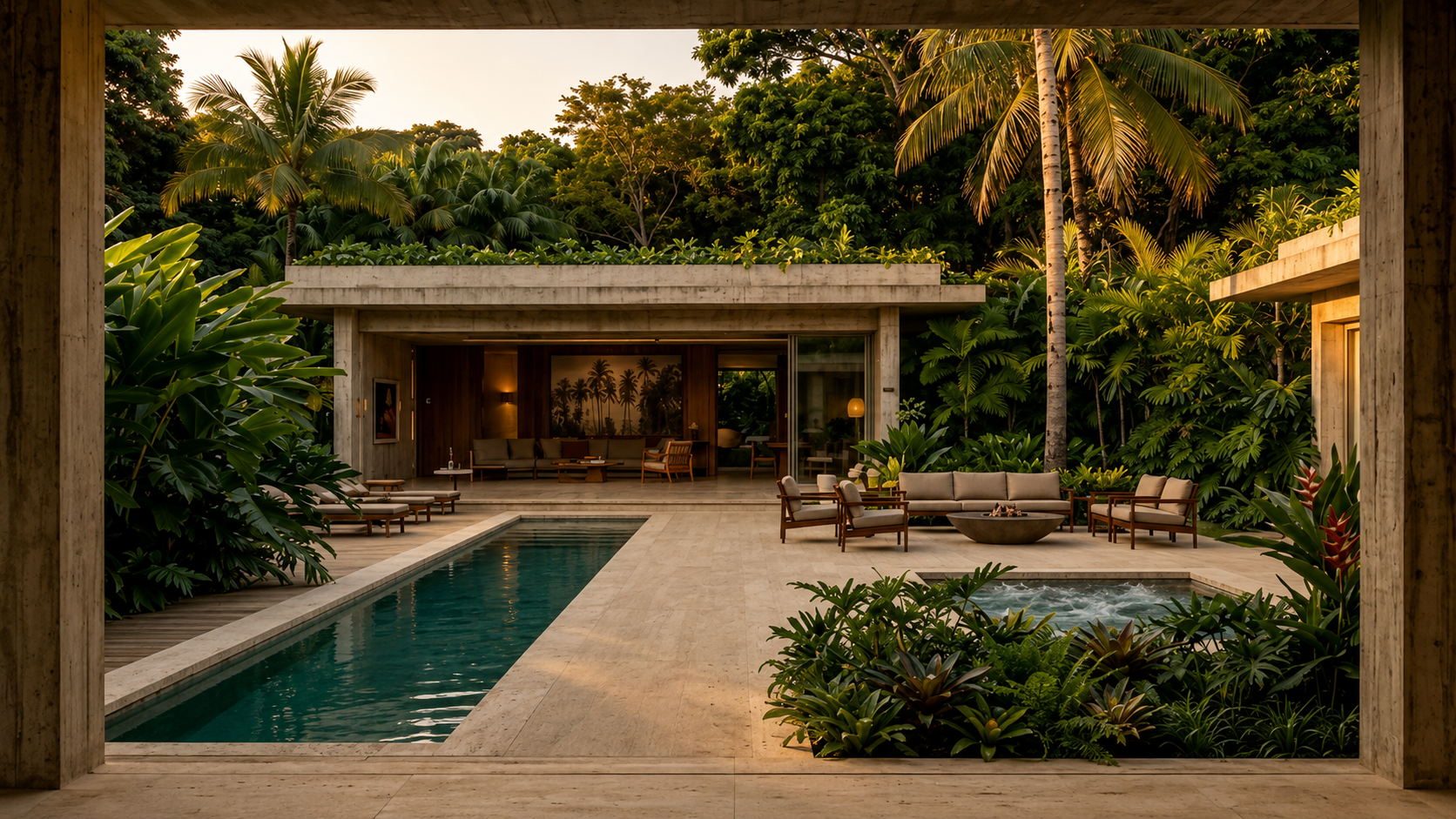
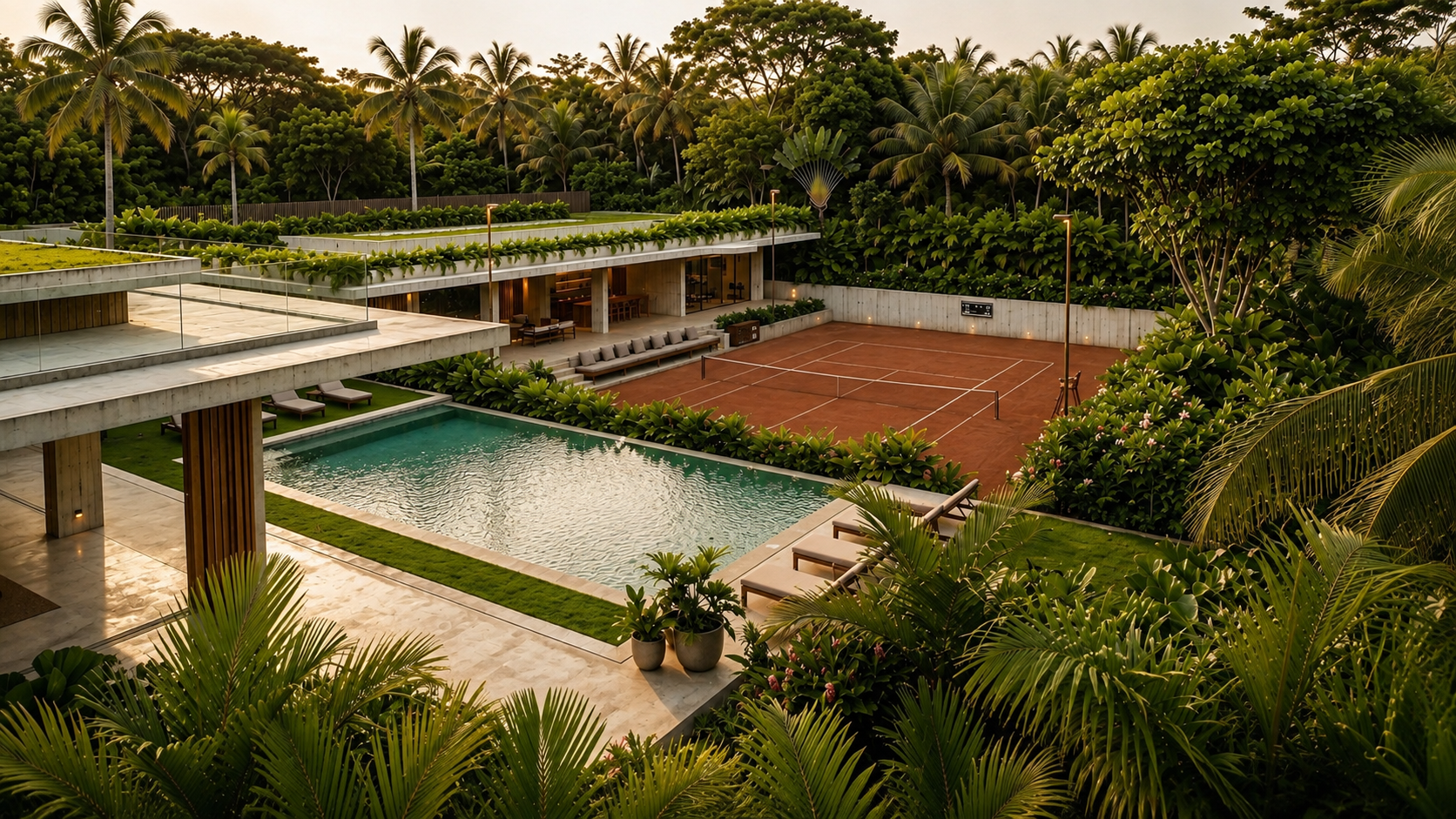
Concept images generated with AI. Visual reference only. Not a real property and not a listing.
Put all of these decisions together and the result is not necessarily the biggest tennis estate, or the one with the most features. It is simply the one we would want to live in.
A home where you can see the court from the pool, walk down for a match, train with a coach, recover in the pavilion and stay there long after the last ball has been hit. Where the clay, landscape and architecture feel like they were conceived together, even if much of the infrastructure making it possible remains out of sight.
That, ultimately, is the tennis home we would build.
The interesting question is what you would do differently. What would your tennis home look like?
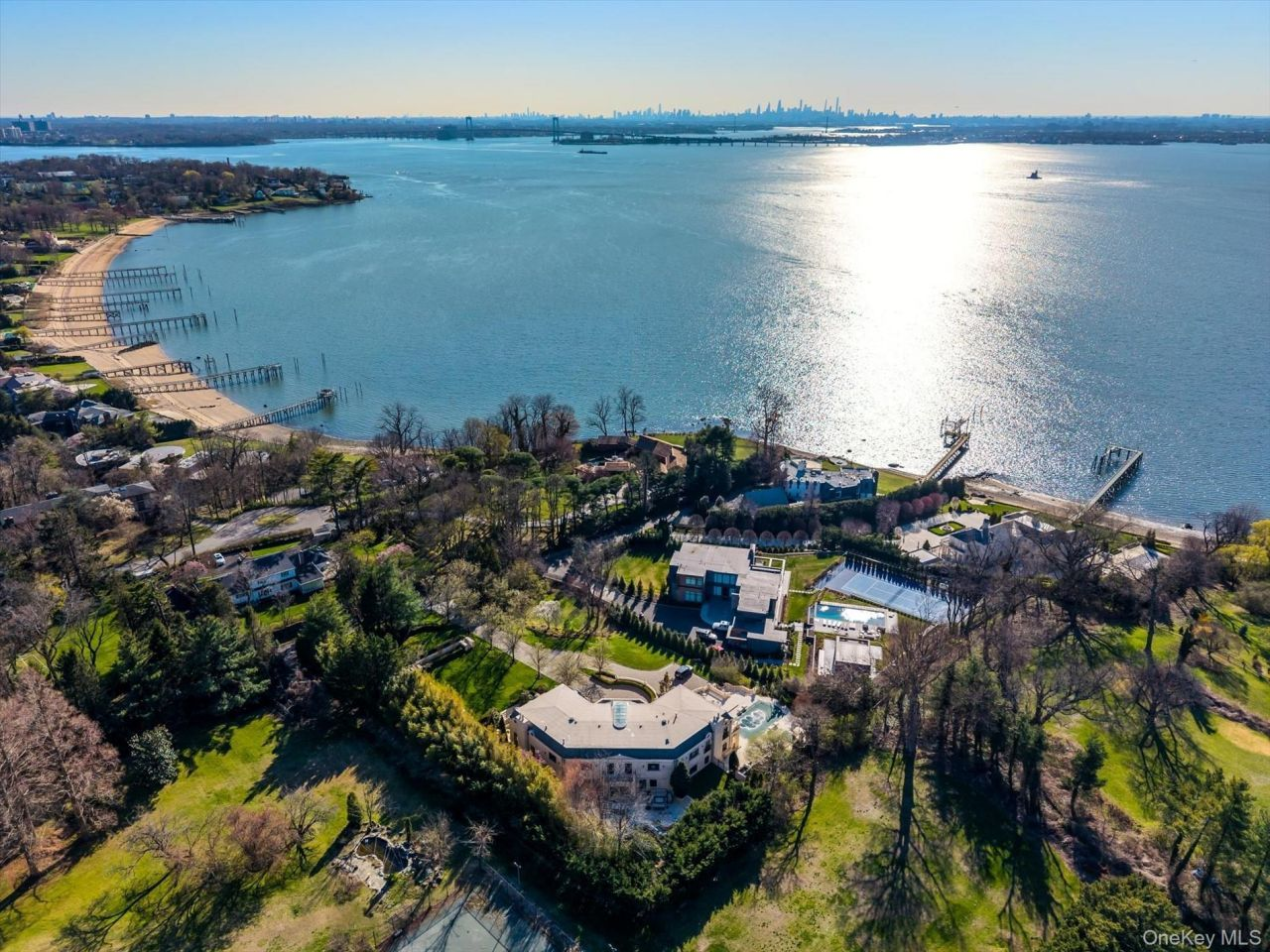
Cover Feature: Kings Point, New York. Photo: OneKey MLS.
A private tennis court needs 7,200 square feet of flat, cleared ground before you count the house. The minimum lot in New York City's most generous single family zoning district is 7,125 square feet.
The court is larger than the lot.
That one comparison explains something the map makes obvious once you look for it. The sport's biggest American audience fills a public park in Queens every summer, and the homes with private courts are nowhere near it. They begin about fourteen miles east, on land drawn a century ago that could not be drawn that way now.
Anyone who wants a court and a New York life is choosing a point on that ring. It starts further out than most people expect, and the reason has nothing to do with taste.
A court is 78 by 36 feet of playing surface. Add the run-off the ITF recommends behind the baselines and beside the tramlines and the real footprint is 120 by 60 feet.
New York does not have room for it. Under section 23-11 of the Zoning Resolution, a lot built to the city's minimums is 95 feet deep, and that holds from the smallest single family district to the most generous. A court is 120 feet long. It runs 25 feet past the back of the lot before anyone has drawn a house, a driveway or a setback.
The city is not short of players or money. It is short of rectangles. And buying the lot next door, which we wrote about this summer, is the usual answer. Here it takes more than one, and the right ones.
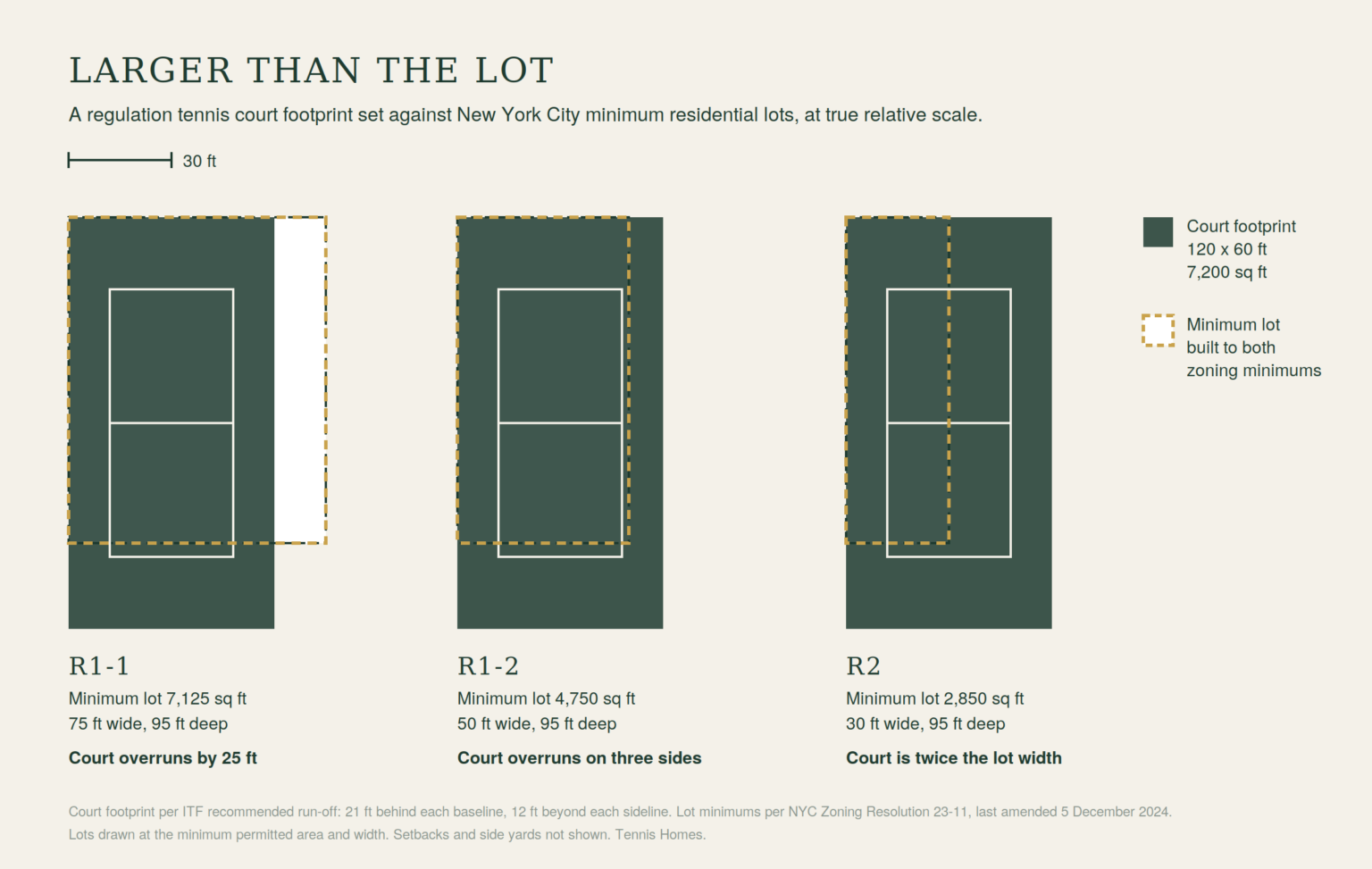
Court footprint per ITF recommended run-off. Lot minimums per NYC Zoning Resolution 23-11, amended 5 December 2024
The best evidence for the constraint is the tournament itself.
From 1915 the championship was played at the West Side Tennis Club in Forest Hills, in a 14,000 seat concrete stadium completed in 1923, the first of its kind in the country. The club sits inside Forest Hills Gardens, a residential community laid out from 1909.
By the mid 1970s the event had outgrown it, and the reasons were spatial rather than sporting. There was nowhere for the audience to park in the narrow lanes around the club, nowhere for the merchandise tents, and by the 1977 tournament, nowhere even for the rubbish, which spilled from the bins and blew across the courts after rain.
In January 1977 the USTA president W.E. Hester was flying into LaGuardia and saw the derelict Singer Bowl from the 1964 World's Fair below him under snow. The Open opened at Flushing Meadows in August 1978. The club fought the move and lost.
The two sites are 2.9 miles apart. The tournament barely travelled. It went from a residential neighbourhood into a public park, because the neighbourhood could not hold it. A private court is the same problem at a twentieth the scale. The land runs out first.
Drive out along the water and the ground changes at the Great Neck peninsula. Kings Point is where private courts stop being an exception and start being a pattern. The Queens enclaves with the largest lots do not come close on that count.
The distance is around 13.6 miles depending on where you land, twenty minutes on a clear road and half an hour when it is not.
Why the courts are there is the same answer as the zoning. These are Gilded Age North Shore villages laid out on estate scale parcels, and a good number of the courts are inherited rather than built. When a Kings Point waterfront estate came to market in 2023, the listing side described its pool, dock and tennis court as grandfathered features that could not be replicated on that waterfront today.
We have written before about grandfathered court lighting. The principle runs deeper than lighting. In villages that have spent a century tightening setbacks and coverage, the court itself becomes the protected thing. The parcel would not permit it now. It is there because it was there first.
That changes what a buyer is shopping for in the first ring. Not a house with room for a court. A house that already has one, with the standing to keep it.
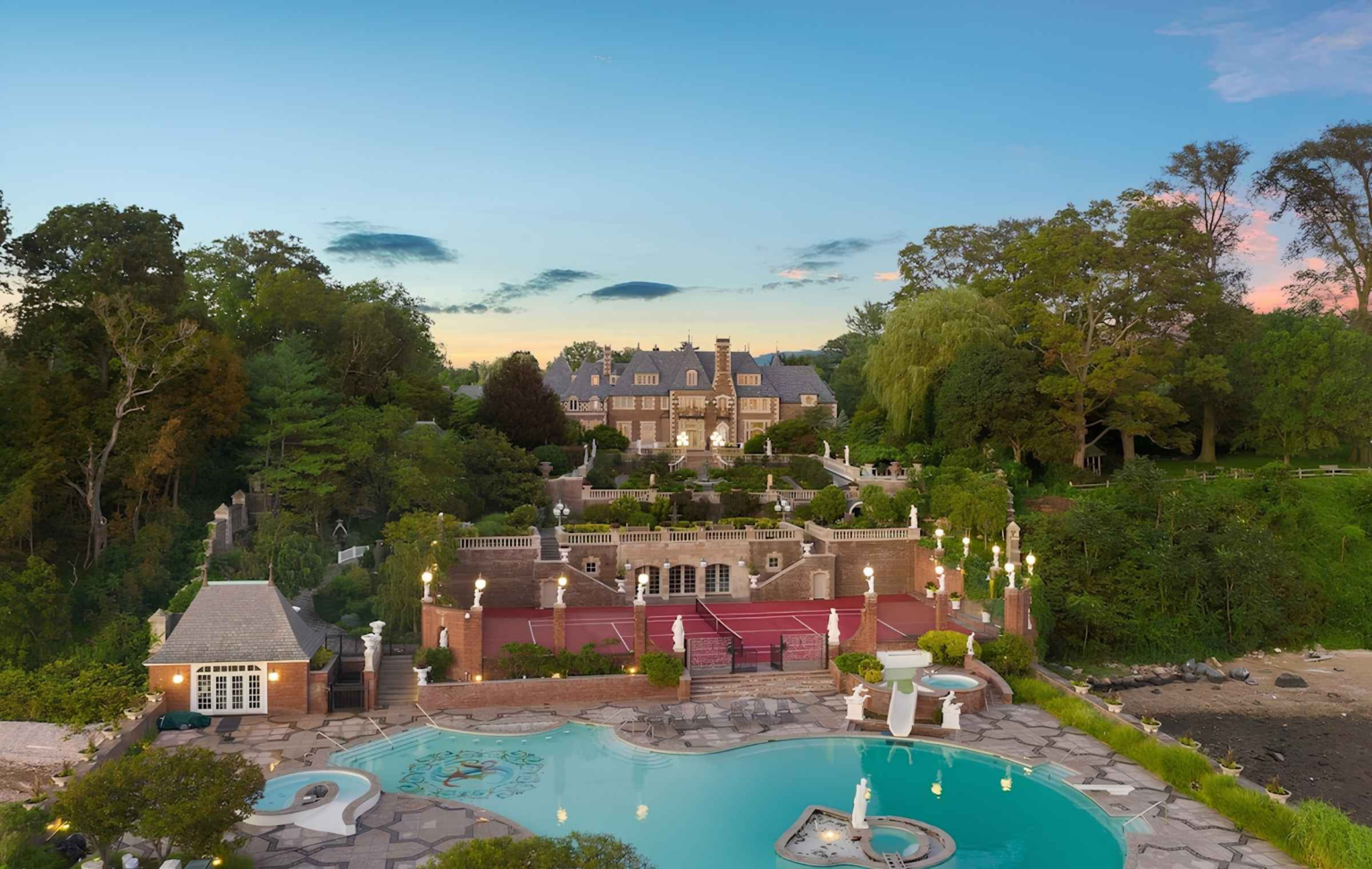
Featured: 26 Pond Road, Kings Point, New York
New York is the clearest case because the numbers are so blunt, but the shape is not local to it.
A court is the same size everywhere. Land is not. So in every market we cover, the private court sits at some distance from the centre, and how far out depends entirely on how the land around that city was drawn and when. Cities that grew before the car left long garden plots. Cities that grew after did not. A court fits in the first and rarely in the second.
In most markets a private court signals taste, or discipline, or how seriously a household takes the game. Around New York it also measures distance. It tells you how far out the family was willing to go to get one.
If you are looking for a court within reach of the city, the search starts on the North Shore and works outward.
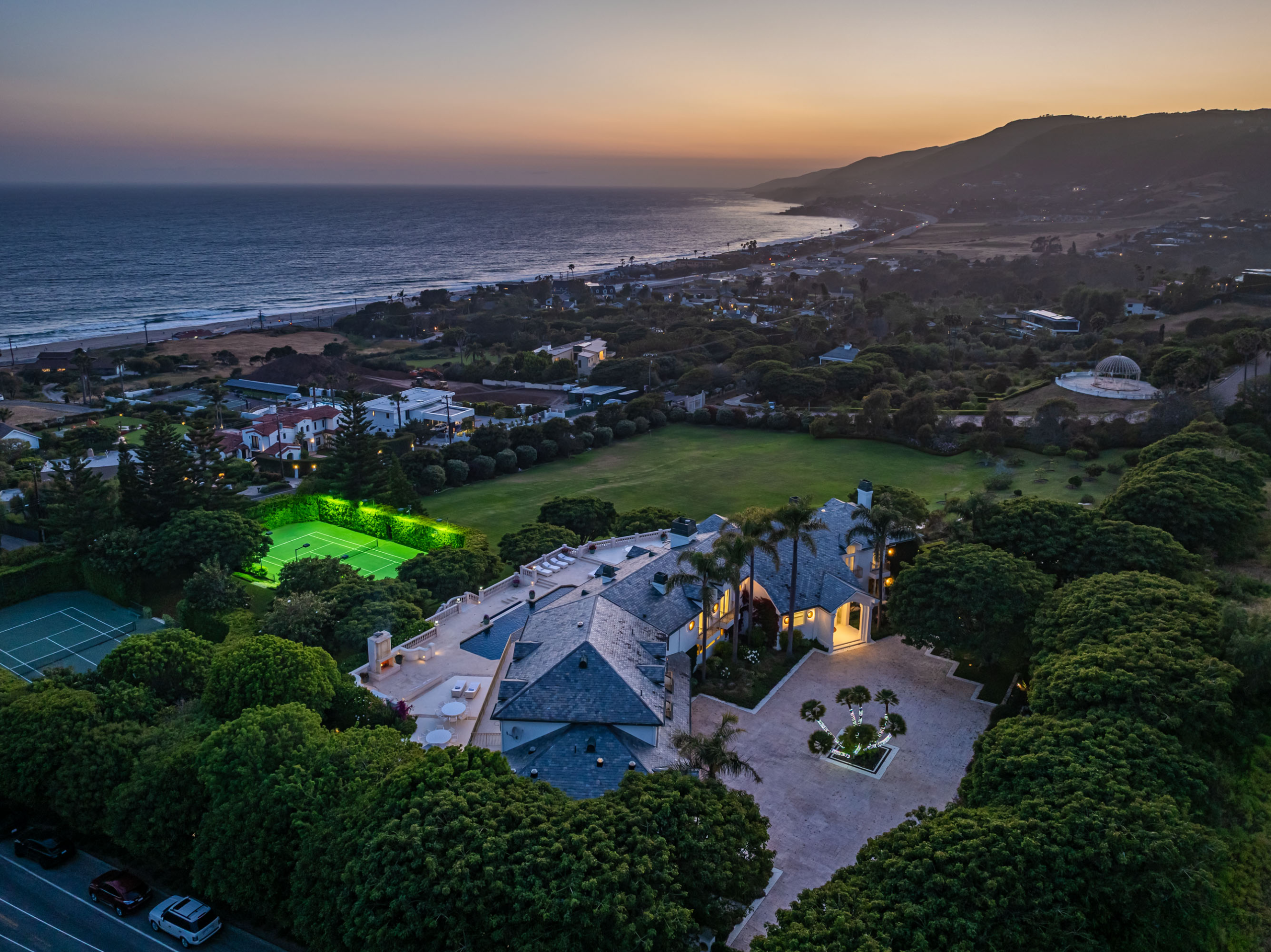
Cover Feature: Malibu Tennis Mansion | Amber Reed, Compass
For two weeks at the end of every August, the most watched tennis in the world is played after dark. Night sessions are the signature of the last Grand Slam of the year, and they are the reason a certain kind of buyer starts thinking about lights on their own court.
Here is the part that rarely comes up. In a growing number of the markets where private courts are most desirable, tennis court lighting rules mean that court could not be lit today. Not at any budget. The lights that exist are there because they were installed before the rules changed, and the rules have since closed behind them.
That changes what an existing lighting system is. It is not a convenience that a future owner can add. It is a right attached to the property, and rights of this kind can be lost more easily than most owners expect.
The formal term is legal nonconforming use. A court lit under the rules that applied at the time keeps the right to stay lit when a stricter ordinance arrives, because zoning changes are generally not applied retroactively to what was already lawful.
The important detail for a buyer is that the protection attaches to the property, not to the person. It does not reset when the house sells, and it cannot be purchased separately or applied for after the fact. Either the lights predate the rule or they do not.
This is not a fringe scenario. Writing about tennis estates in California, Forbes Global Properties noted that Los Angeles County restricts residents from building new courts with lights, and that buyers therefore favor an estate where the lights already exist. That is the whole dynamic in two sentences: the restriction creates the scarcity, and the scarcity shows up in what buyers want.
We covered how these regimes differ across markets in Tennis Court Lighting Regulations: What Homeowners Need to Know, including national light pollution law in France and the planning permission requirement in the UK. What that piece did not answer is the question underneath it, which is what happens to an existing system when its owner decides to improve it.
This is where owners get caught.
Protection covers continuing what is already there. It does not automatically cover replacing it. In a number of jurisdictions, swapping old fixtures for new ones is treated as a fresh installation rather than maintenance, and a fresh installation has to meet the current standard. The permit application that was meant to modernize the court is the same application that measures it against rules it was never built to satisfy.
The language in the codes is explicit. In Flagstaff, Arizona, the first International Dark Sky City, the zoning code requires an outdoor lighting permit before the installation, modification, or replacement of any outdoor light fixture, and states that any modification of an existing fixture must comply with the division. It goes further. Where cumulative replacements of legally installed fixtures reach 25 percent or more of the lumens the property would be permitted today, the entire property must be brought into compliance.
Los Angeles County's Rural Outdoor Lighting District ordinance applies to new lighting, major additions, and replacement lighting alike. Within that district it also sets a curfew: outdoor lighting off between 10 pm and sunrise.
So the owner who decides to retrofit to LED, for entirely sensible reasons, can find that the decision is not reversible. In What Private Tennis Court Lighting Actually Costs we set out the retrofit economics, from a fixture swap at the low end to a complete system upgrade at the high end. Those numbers still hold. What they do not capture is the risk sitting alongside them, which is that in a restricted market the cheapest path and the safest path may be the same one, and the expensive path may cost the court its lights entirely.
Two other ways the protection ends are worth knowing.
The first is amortization. Some municipalities do not grandfather indefinitely. They set a compliance deadline instead. Boulder, Colorado adopted its outdoor lighting ordinance in 2003 and gave owners with non-compliant existing installations fifteen years to comply. As of November 2018, every property must demonstrate compliance. Fifteen years is long enough that most owners stop thinking about it, which is exactly the problem.
The second is discontinuance. Nonconforming rights are generally tied to continued use, and a system that sits unused or falls into disrepair can be treated as abandoned. The threshold varies by jurisdiction and needs to be checked locally. The principle does not vary: a court that goes dark for long enough may not get to come back on.
None of this is visible in a listing. A property description says lighted court. It does not say under what permission, or whether that permission survives a bulb.
The questions that resolve it are short.
Were the lights permitted, and when?
A dated permit is the whole answer. If the lights predate the current ordinance, that date is the asset.
Is there documentation of nonconforming status?
Some jurisdictions issue a certificate. Many do not, in which case the permit history and evidence of continuous use carry the weight.
What triggers a new application here?
Ask the municipality directly, not the contractor. The question is specific: does replacing fixtures on this court require compliance with current standards, and at what threshold.
Is there a curfew, and what is it?
A lit court with a 9 pm cutoff is a different property from one with no restriction. Both are worth having. They are not the same thing.
If the system were damaged, could it be rebuilt?
Nonconforming structures often lose protection when damage passes a defined threshold. In storm exposed markets this is a real question rather than a theoretical one.
For sellers the list is the same, assembled in advance. A permit file ready at the point of offer removes the one thing a careful buyer would otherwise use to discount the court.
In a market where new floodlights are not being approved, two courts that photograph identically are not equivalent assets. One plays after dark. The other never will, and no amount of money changes that.
The difference is a piece of paper, and it is knowable before you make an offer. We can tell you quickly whether a specific court and market make evening play realistic, and what to ask for before you commit.
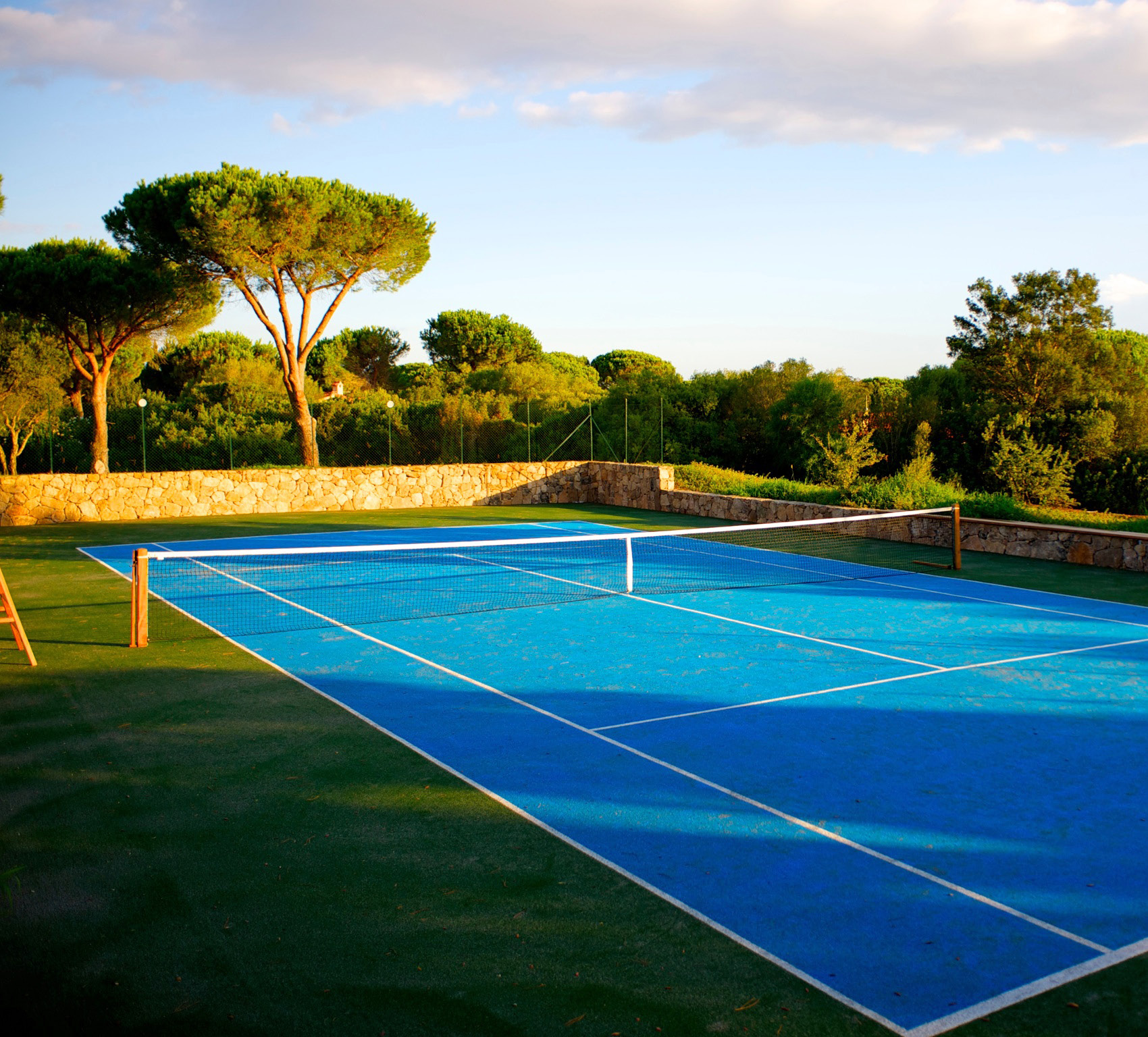
Cover Feature: Villa H2O | Luxury Esmeralda
There is a kind of traveler who decides where to go by asking one question first: Is there a court? Everything else, the beach, the town, the restaurant everyone talks about, arranges itself around the answer.
If that sounds like you, then you already know the frustrating part. Finding a home with a private court is not the hard bit. Finding one that is still free on the weeks you actually wanted is. And the reason usually has nothing to do with luck.
It is the middle of August as we write this. Somewhere in Provence, a family is finishing their second week in a house they have taken for four summers running. Before they leave, someone will ask whether they want it again next year. They will say yes, over lunch, without much deliberation, and that house will not appear anywhere next spring.
This is how most of the good ones go. Peak weeks in established markets are settled six to twelve months before arrival, and the very best homes move earlier still, quietly, between people who already know each other. Returning guests are offered first refusal, usually with a deadline attached, and the conversation tends to happen while they are still in the house.
Which means the date that matters is not the day a home is published. It is the day the last guest let it go. By the time you are looking, you are choosing from what came back.
Every luxury rental market works roughly like this, so it would be easy to stop there. We think the court changes the maths in a way worth spelling out, and this is our own read rather than something the market has agreed on.
With a conventional villa, missing the window is an inconvenience. You shift a week, or you take the house along the same lane, and the holiday is more or less the one you planned. The substitutes are real.
Now put a court on it. Say you play on clay and you want two weeks in Provence in August. The list of houses that genuinely fit is short before anyone else has even started looking. Filter again for a court that is not shared with the property next door, or for lights so you can play after the heat has gone out of the day, and the list is shorter still. There is very little to fall back on, because the fallback was never there.
That is the whole argument for starting early. Not urgency for its own sake. Just a smaller pool than you would expect.
For July and August on the French Riviera and in Provence, the useful window opens around October and closes in February. Most houses run Saturday to Saturday through high season, and for the larger estates some owners would rather place the whole of August with one family than break it into weeks.
Saint-Tropez and Ramatuelle are where this bites hardest. La Tropézienne and Villa Côte d'Or, above Pampelonne, are the kind of houses that window exists for. In Cannes, Le Castel sits on eleven acres around a clay court, and Palais Belle Époque looks down over the bay from the heights.
Porto Cervo works on a similar autumn window, but the terms there are less predictable. Some owners there place July and August in month long blocks and open up weekly stays only on either side of the summer. Others take weeks all season. It is worth checking rather than assuming, in both directions. Villa Roccia Blu and Ruini Padel Villa are both available by the week, which in that market is not a given. Further down the east coast at San Teodoro, Villa H2O sits outside that stretch entirely, which is worth remembering when Porto Cervo tightens.
The Balearics work differently again. The pool of houses at the top of the market is small, and a good share of it never really circulates, moving instead between the same families year after year. Casa Vella in Ibiza and Villa Solana in Mallorca both belong to the category where the court, not the pool, is the reason you are there.
High season across the Caribbean runs from mid December through April, and the fortnight around Christmas and New Year is the most contested stretch of the calendar anywhere. Minimum stays of ten to fourteen nights are close to standard at the top of the market over those dates, which changes what you are deciding. You are not choosing a week. You are committing to a fortnight, at the highest rates of the year, and those weeks are largely gone by the end of the summer that precedes them.
In St Barths, Villa Blanc Bleu sits above Lurin and Villa Ela above Flamands. In Turks and Caicos, Tranquility Tennis Estate and Hawksbill Tennis Estate are on Grace Bay, and Triton Villa on Providenciales carries clay, hard court, padel and pickleball on a single property.
There is a second winter that fewer people think about. Marrakech and Koh Samui both peak while Europe is cold, and neither compresses the way the Caribbean does. Villa Palmeraie has a clay court in the Palmeraie. Lotus Estate on Koh Samui runs to ten bedrooms with full staff. If you play every day and you are not attached to being in the Caribbean for the last week of December, these markets stay open considerably longer and reward you for the flexibility.
For a long time the East End had the simplest rule of all. Commit by February or take whatever is left in May.
That rule has softened. More owners now rent rather than sell, and shorter, more flexible terms have become normal, so the season no longer clears in a single moment the way it once did. If you have been told the Hamptons is impossible after spring, that is no longer quite true.
It is only true in the middle of the market, though. Turnkey houses in the strongest locations still go early, and a house with a properly kept court belongs to that group by definition. Two speeds, running at once, and the court decides which one applies to you.
Start with where you want to be and what you play. Tennis, padel, pickleball, or some combination, because a household split across two sports narrows the search faster than any date does. Triton Villa carries all four on one estate, which is rare enough to solve that problem outright.
Then be honest about how much you will actually use it. Someone playing every morning needs to know early whether the court is shared with the neighbors, whether it is lit, and who is looking after it while they are there. Someone who will hit twice in a fortnight can let all of that go and choose on the view instead.
After that, weigh the address against the calendar. The most contested locations are the most expensive and the least forgiving, and they close first. Move half an hour down the coast and you will often find better terms, more availability and shorter minimum stays, on a court of the same standard. When your dates are fixed and your address is not, that is usually where the answer is hiding.
One last thing, easy to skip and awkward to discover late. Ask about the changeover day and the minimum stay before you have fallen for the house, not after. And read the cancellation terms, which vary by property and by representative, before the deposit rather than once it has been paid.
If you are thinking about next summer, this is the month to start. If you are thinking about this winter, you are already inside the window and the good weeks are going.

We use cookies to personalize your experience and analyze our traffic. See Privacy Policy for more information. Not consenting or withdrawing consent, may adversely affect certain features and functions.
You’ll receive a confirmation email. Unsubscribe from any issue.
The Tennis Homes Newsletter shares homes defined by sport, design, and location. Expect select listings, market context, and stories from within the tennis lifestyle.
You’ll receive a confirmation email. Unsubscribe from any issue.
The Tennis Homes Newsletter shares homes defined by sport, design, and location. Expect select listings, market context, and stories from within the tennis lifestyle.
Properties and editorial, once a week.