

The Tennis Home Capitals of the United States
Seen From Above
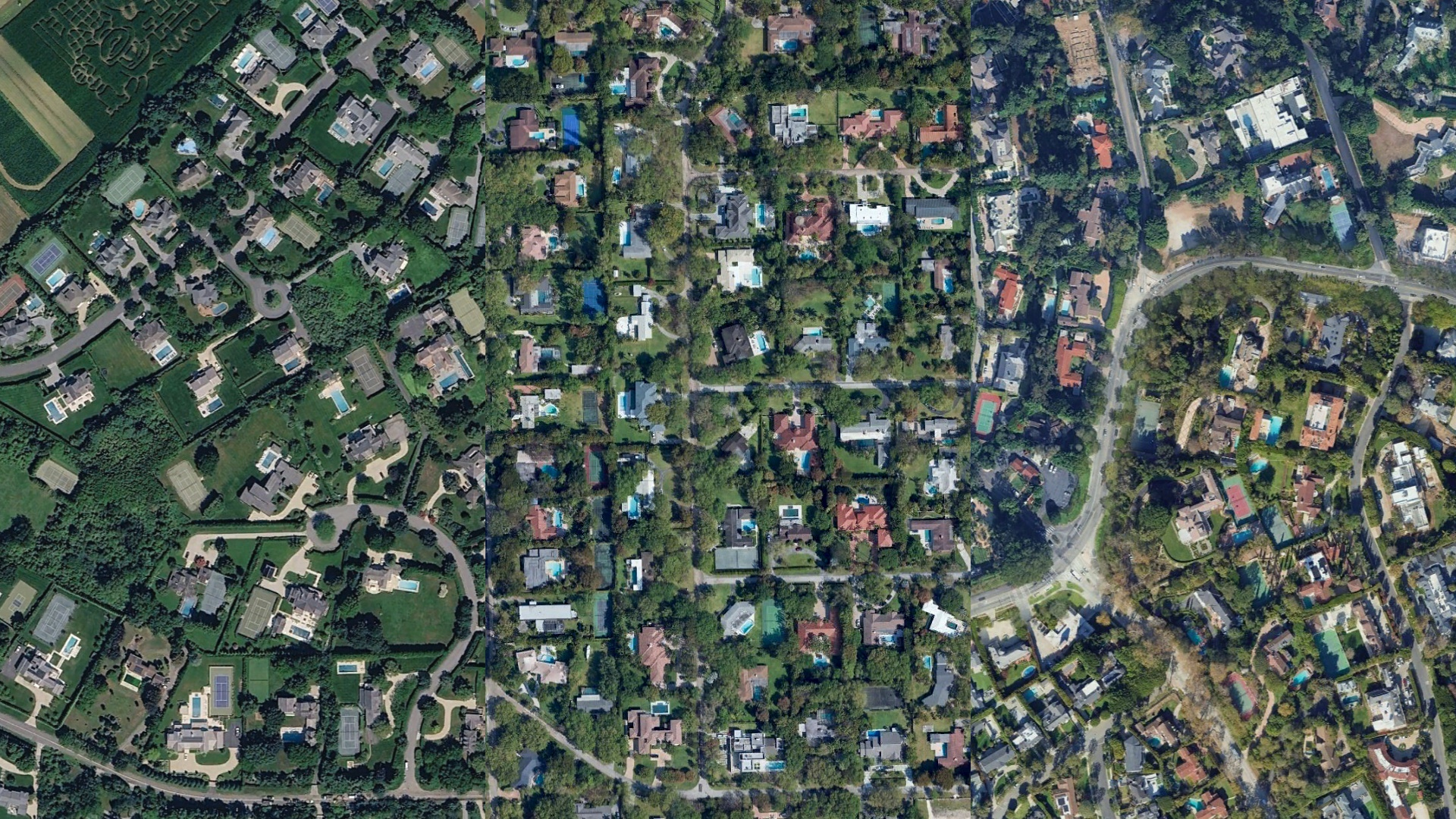
Look down on Water Mill from above on a summer morning and the courts appear one after another: a green rectangle behind a hedge, a clay court beside a pool, another beside the farm fields. In most of the United States a private court is a rare thing. In a few places it is almost expected.
Based on our internal research, three areas stand apart: the Hamptons on Long Island, the Westside of Los Angeles, and Pinecrest, south of Miami. In the densest parts of each, a single square mile holds somewhere around twenty private tennis courts.
They could hardly be more different. One plays a short, intense season by the Atlantic. One plays almost all year under a dry California sky. One plays its best tennis in winter, when the rest of the country is indoors. Seen side by side from above, even the way the courts sit on the land is different.
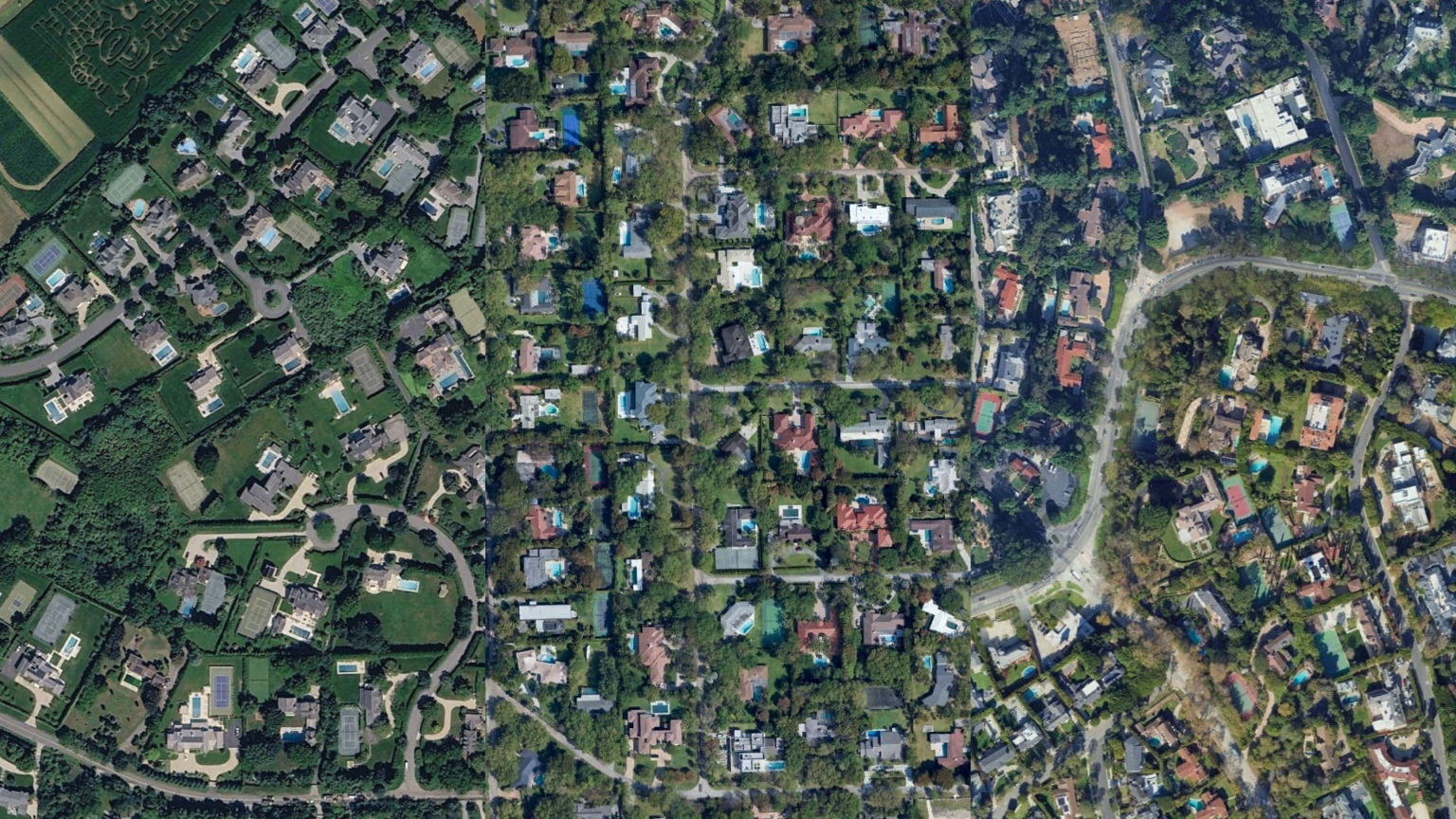
Water Mill, Pinecrest and Bel Air from above. Imagery ©2026 Google, Airbus
Where Homes With Tennis Courts Cluster in the United States
| Area | Where the courts cluster | Private courts per square mile (our estimate) | The tennis season | The club or event that came first |
|---|---|---|---|---|
| The Hamptons, Long Island | Water Mill and Bridgehampton | 17 to 24 | Roughly Memorial Day to Labor Day | The Meadow Club, Southampton, 1887 |
| The Westside, Los Angeles | Bel Air and Brentwood | About 20 | Year round; rain falls mostly November to April | The Los Angeles Tennis Club, 1920 |
| Pinecrest, Miami-Dade | The village of Pinecrest | About 22 | Year round; the dry, mild winter is the main season | The Orange Bowl, Miami Beach, 1947 |
A note on the numbers. They are estimates from our own research, and we treat them as ballparks rather than a study. The three areas are so close that we do not rank them; what stands out is how far ahead of everywhere else they are.
Three Ways to Fit a Court
The density is similar. The land is not. In Water Mill the lots are wide and open, cut out of former farmland, and a court usually sits in its own clearing of lawn, framed by tall hedges with room to spare. In Pinecrest the streets run in a neat grid of roughly acre lots under a heavy tree canopy, and the courts are tucked in beside the pool, half hidden by the trees. In Bel Air the roads wind along the hillsides, the lots are tighter and steeper, and a court often sits on a terrace cut into the slope, with far less breathing room between neighbours.
Tennis Homes in the Hamptons
The Hamptons did not start with private courts. They started with a club. The Meadow Club was founded in Southampton in 1887, on flat farmland with sandy soil, and its grass courts hosted the Southampton Invitation for 85 editions. Bill Tilden won it three times. Bobby Riggs won it four.
The tournament ended in 1973. The habit did not. By our own estimate the Hamptons hold well over a thousand homes with a private court, and the densest stretch runs through Water Mill and Bridgehampton, where the land is flat enough for a level court without a fight.
The season is short, which is exactly why the court matters. From roughly Memorial Day to Labor Day a Hamptons home fills with family and guests, and the court is where the day begins: a set before the beach, another when the heat drops in the late afternoon. Many owners here choose Har-Tru, the green clay that is softer on the body over a long summer.
SkyBox, a modern estate on close to ten acres in Water Mill by 1100 Architect, shows the idea at its simplest: a court with a courtside lounge, looking over farmland and polo fields to the Atlantic. Down on the water, Mecox Bay Estate shows it at full scale, two residences on a private peninsula with a floodlit hard court.
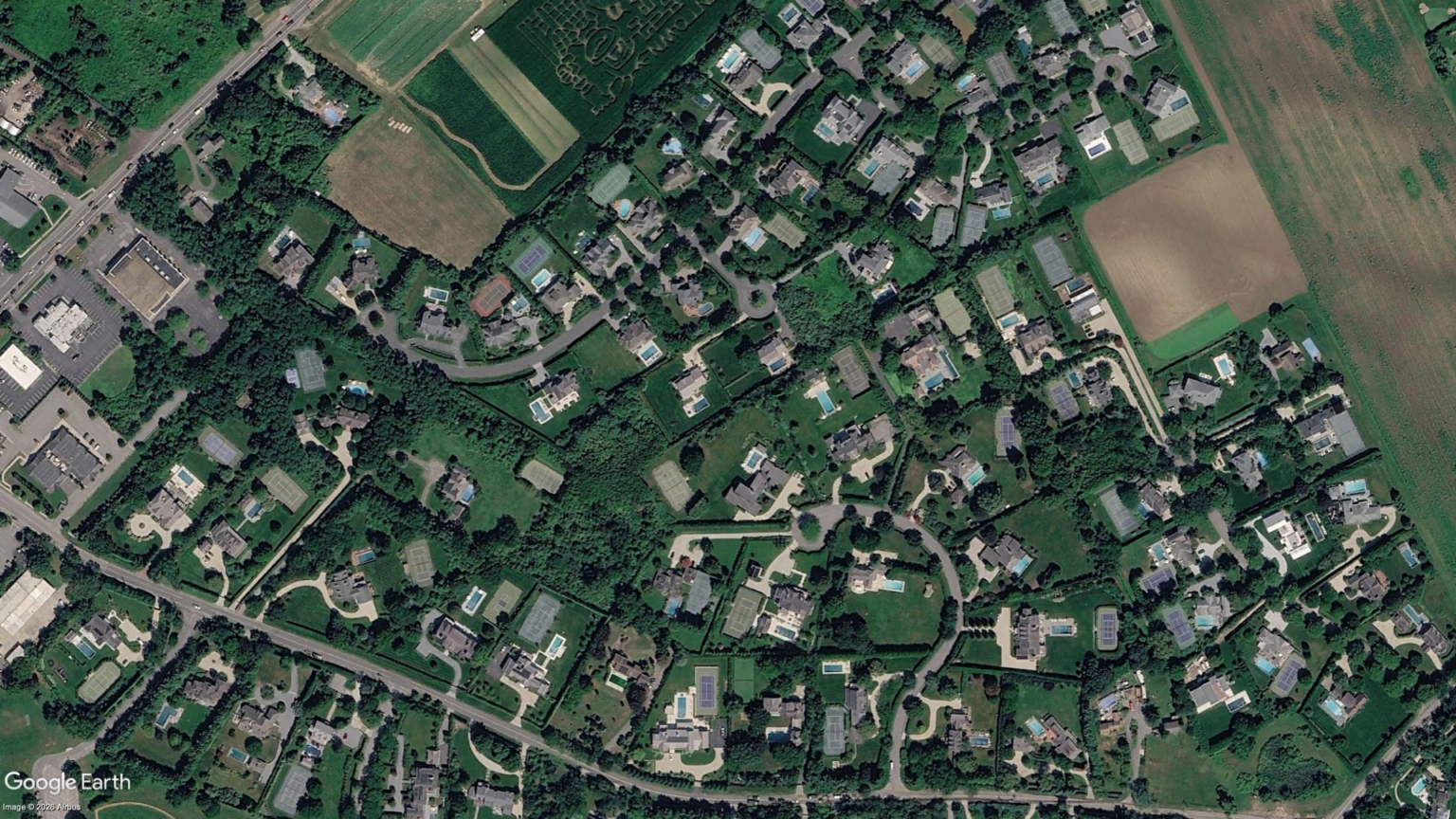
Water Mill from above. Imagery ©2026 Google, Airbus
Homes With Tennis Courts on the Westside of Los Angeles
Bel Air and Brentwood are neighbourhoods of the City of Los Angeles, on its Westside. The city learned the game in its clubs. The Los Angeles Tennis Club was incorporated in 1920 and held the Pacific Southwest tournament into the early 1980s; Fred Perry, Don Budge, Jack Kramer and Billie Jean King all played there. In 1929 the Beverly Hills Tennis Club opened on Maple Drive, and in 1937 Groucho Marx and Charlie Chaplin played doubles there.
The climate did the rest. Winter highs run from the upper 60s to the low 70s, and almost all of the year's rain falls between November and April. A court here is not a summer feature. It is used in January.
The tradition runs west along the coast to Malibu, where Malibu Tennis Sanctuary sets a floodlit hard court beside an infinity pool on about an acre and a quarter. And the story is not finished: the 2028 Olympic tennis event is planned for Dignity Health Sports Park in Carson.
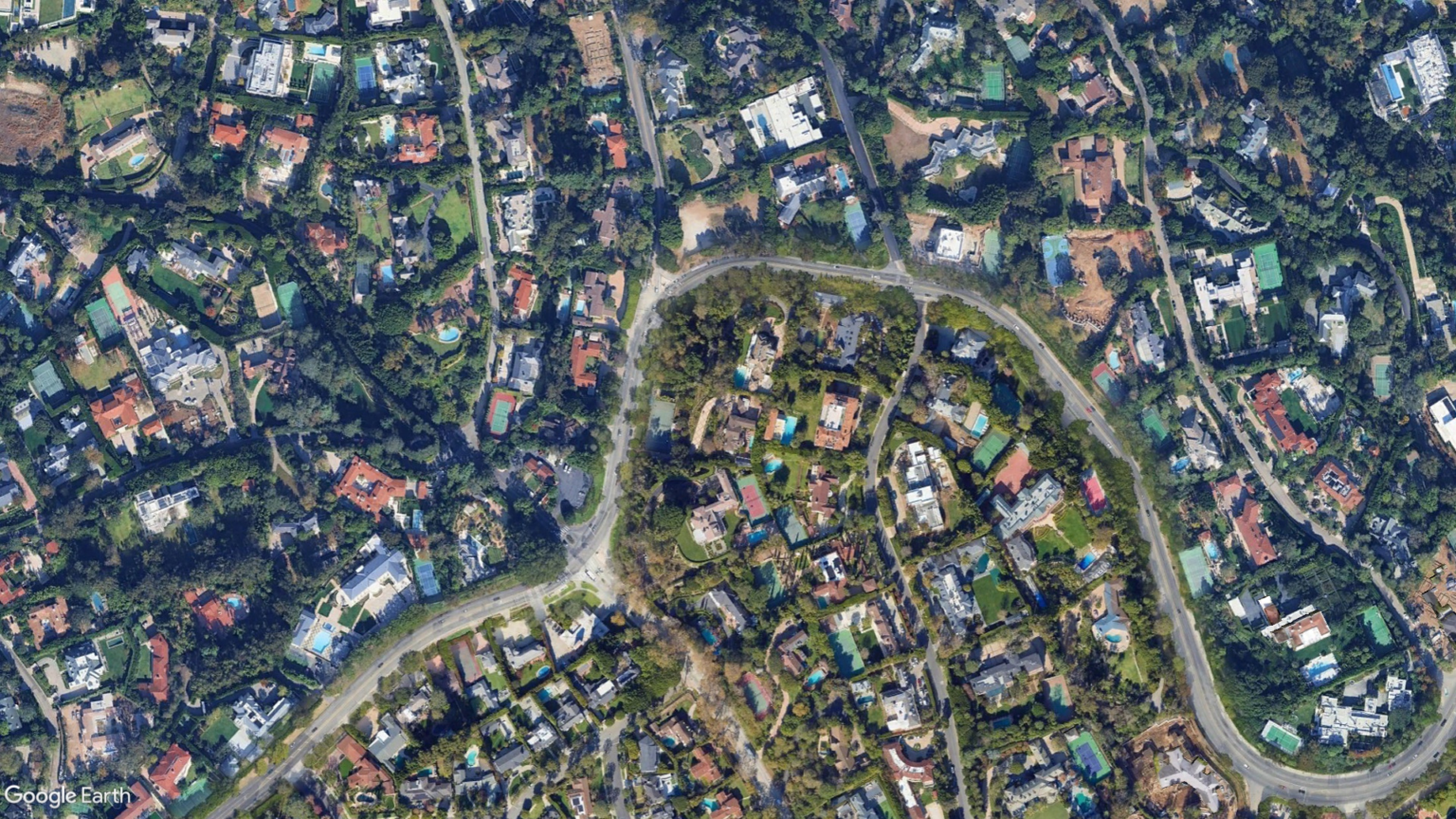
Bel Air from above. Imagery ©2026 Google
Homes With Tennis Courts in Pinecrest, Miami-Dade
Pinecrest is its own village in Miami-Dade County, south of the City of Miami, and its tennis story belongs to the wider Miami area. It begins with a father and a daughter. In 1947 Eddie Herr started the Orange Bowl in Miami Beach so his daughter, Suzanne, would have winter competition. It became one of the great junior events in the world: Chris Evert, Björn Borg, Ivan Lendl, Roger Federer and Coco Gauff are among its champions. In 1985 Butch Buchholz added a professional event that settled at Crandon Park on Key Biscayne from 1987 to 2018, the tournament now called the Miami Open.
Both are played in the dry season, and that is the key to tennis here. Summers are hot and humid, with highs in the mid 80s to mid 90s and a wet season from mid May to mid October; winters are short, mild and dry, with January averaging about 69°F. The best tennis of the year is played when the north is under snow.
Pinecrest gave the game room. The village was built out in the 1950s and 1960s as ranch homes on acre lots, and an acre has space for a court, a pool and a garden side by side. Pinecrest Sanctuary is a current example: a lighted, full size hard court that converts into two pickleball courts, a separate guest residence and a private putting green on 0.89 acres.
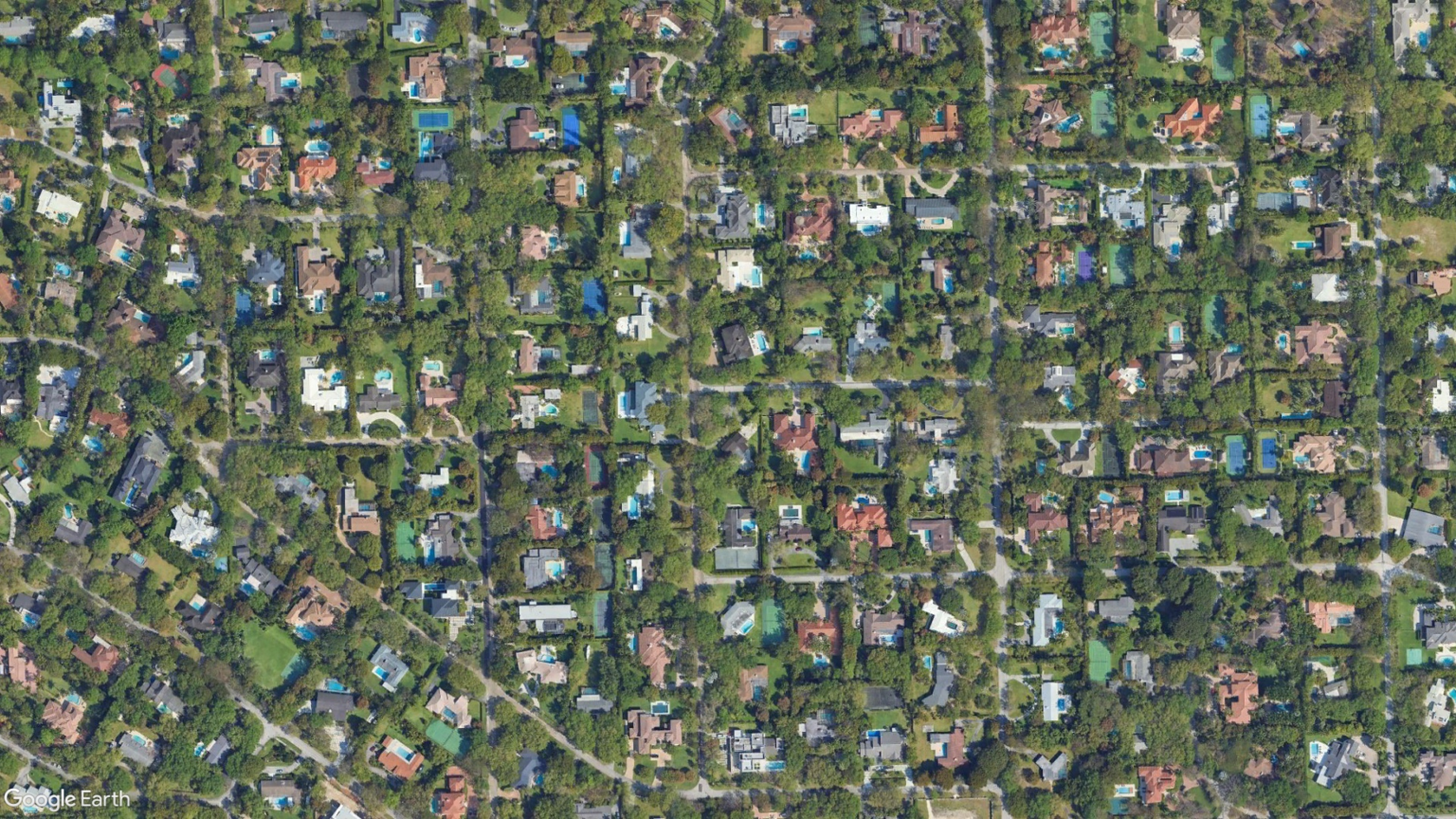
Pinecrest from above. Imagery ©2026 Google
What Makes a Tennis Home Capital
Put the three side by side and a pattern appears. Each had a club or a tournament long before it had private courts. Each had land in lots large enough for a court beside the home. And each has a reason to play that outlasts a single summer, whether a season so concentrated that every morning counts, or a climate that keeps the court in use from January to December.
That is also why a court in one of these places reads differently to a buyer. Two homes of similar size can sit in very different categories once you look at how the court was placed, built and surfaced.
Find Your Court in the Capitals
Looking for a tennis home in the Hamptons, Los Angeles or Miami, or know someone who is? We know these markets court by court. Send this their way, or write to us.