

August 27, 2026
Cover Feature: Kings Point, New York. Photo: OneKey MLS.
Larger Than the Lot
A private tennis court needs 7,200 square feet of flat, cleared ground before you count the house. The minimum lot in New York City's most generous single family zoning district is 7,125 square feet.
The court is larger than the lot.
That one comparison explains something the map makes obvious once you look for it. The sport's biggest American audience fills a public park in Queens every summer, and the homes with private courts are nowhere near it. They begin about fourteen miles east, on land drawn a century ago that could not be drawn that way now.
Anyone who wants a court and a New York life is choosing a point on that ring. It starts further out than most people expect, and the reason has nothing to do with taste.
The Rectangle Nobody Can Shrink
A court is 78 by 36 feet of playing surface. Add the run-off the ITF recommends behind the baselines and beside the tramlines and the real footprint is 120 by 60 feet.
New York does not have room for it. Under section 23-11 of the Zoning Resolution, a lot built to the city's minimums is 95 feet deep, and that holds from the smallest single family district to the most generous. A court is 120 feet long. It runs 25 feet past the back of the lot before anyone has drawn a house, a driveway or a setback.
The city is not short of players or money. It is short of rectangles. And buying the lot next door, which we wrote about this summer, is the usual answer. Here it takes more than one, and the right ones.
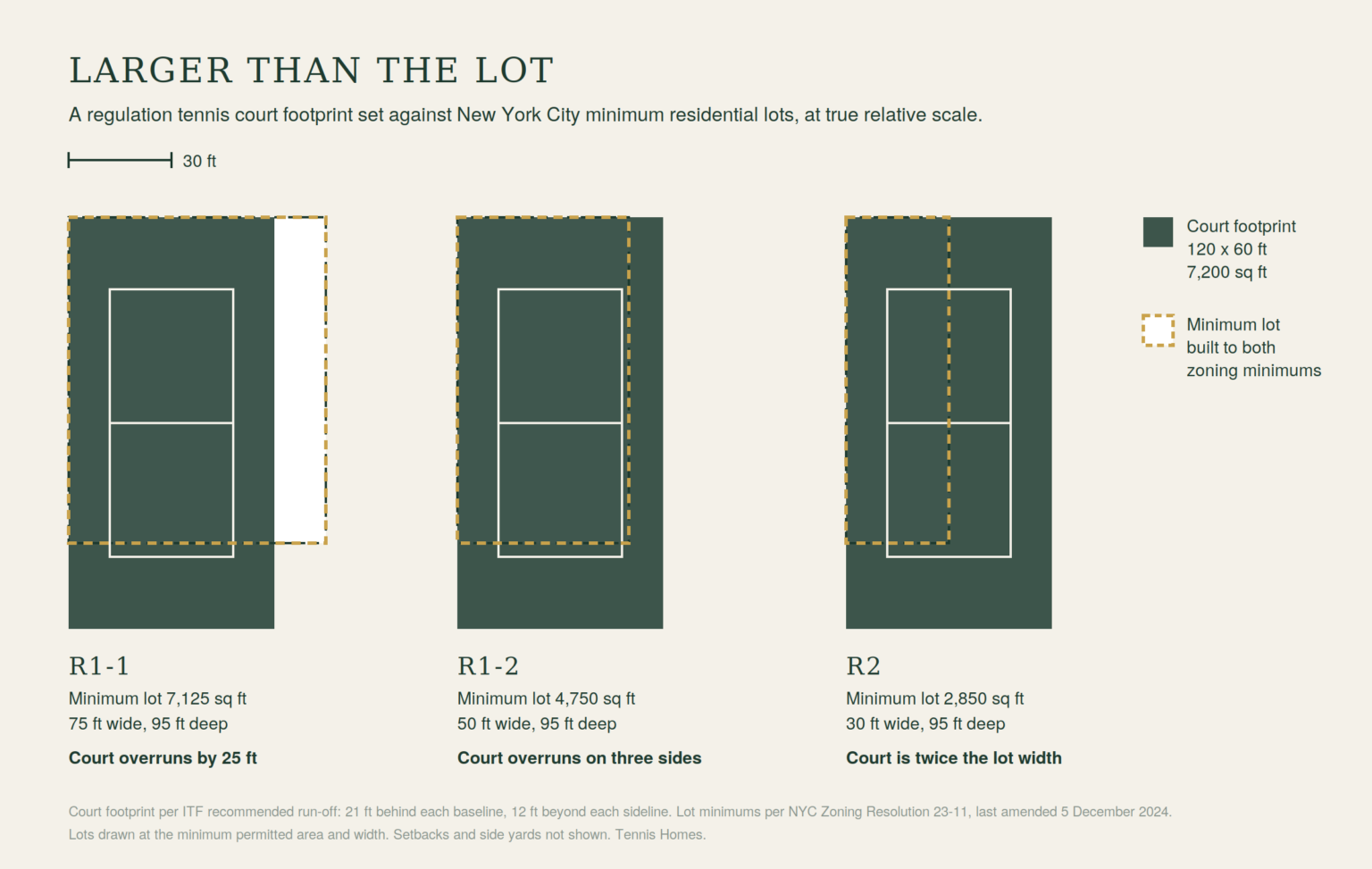
Court footprint per ITF recommended run-off. Lot minimums per NYC Zoning Resolution 23-11, amended 5 December 2024
The Tournament Ran Into the Same Wall
The best evidence for the constraint is the tournament itself.
From 1915 the championship was played at the West Side Tennis Club in Forest Hills, in a 14,000 seat concrete stadium completed in 1923, the first of its kind in the country. The club sits inside Forest Hills Gardens, a residential community laid out from 1909.
By the mid 1970s the event had outgrown it, and the reasons were spatial rather than sporting. There was nowhere for the audience to park in the narrow lanes around the club, nowhere for the merchandise tents, and by the 1977 tournament, nowhere even for the rubbish, which spilled from the bins and blew across the courts after rain.
In January 1977 the USTA president W.E. Hester was flying into LaGuardia and saw the derelict Singer Bowl from the 1964 World's Fair below him under snow. The Open opened at Flushing Meadows in August 1978. The club fought the move and lost.
The two sites are 2.9 miles apart. The tournament barely travelled. It went from a residential neighbourhood into a public park, because the neighbourhood could not hold it. A private court is the same problem at a twentieth the scale. The land runs out first.
Fourteen Miles East
Drive out along the water and the ground changes at the Great Neck peninsula. Kings Point is where private courts stop being an exception and start being a pattern. The Queens enclaves with the largest lots do not come close on that count.
The distance is around 13.6 miles depending on where you land, twenty minutes on a clear road and half an hour when it is not.
Why the courts are there is the same answer as the zoning. These are Gilded Age North Shore villages laid out on estate scale parcels, and a good number of the courts are inherited rather than built. When a Kings Point waterfront estate came to market in 2023, the listing side described its pool, dock and tennis court as grandfathered features that could not be replicated on that waterfront today.
We have written before about grandfathered court lighting. The principle runs deeper than lighting. In villages that have spent a century tightening setbacks and coverage, the court itself becomes the protected thing. The parcel would not permit it now. It is there because it was there first.
That changes what a buyer is shopping for in the first ring. Not a house with room for a court. A house that already has one, with the standing to keep it.
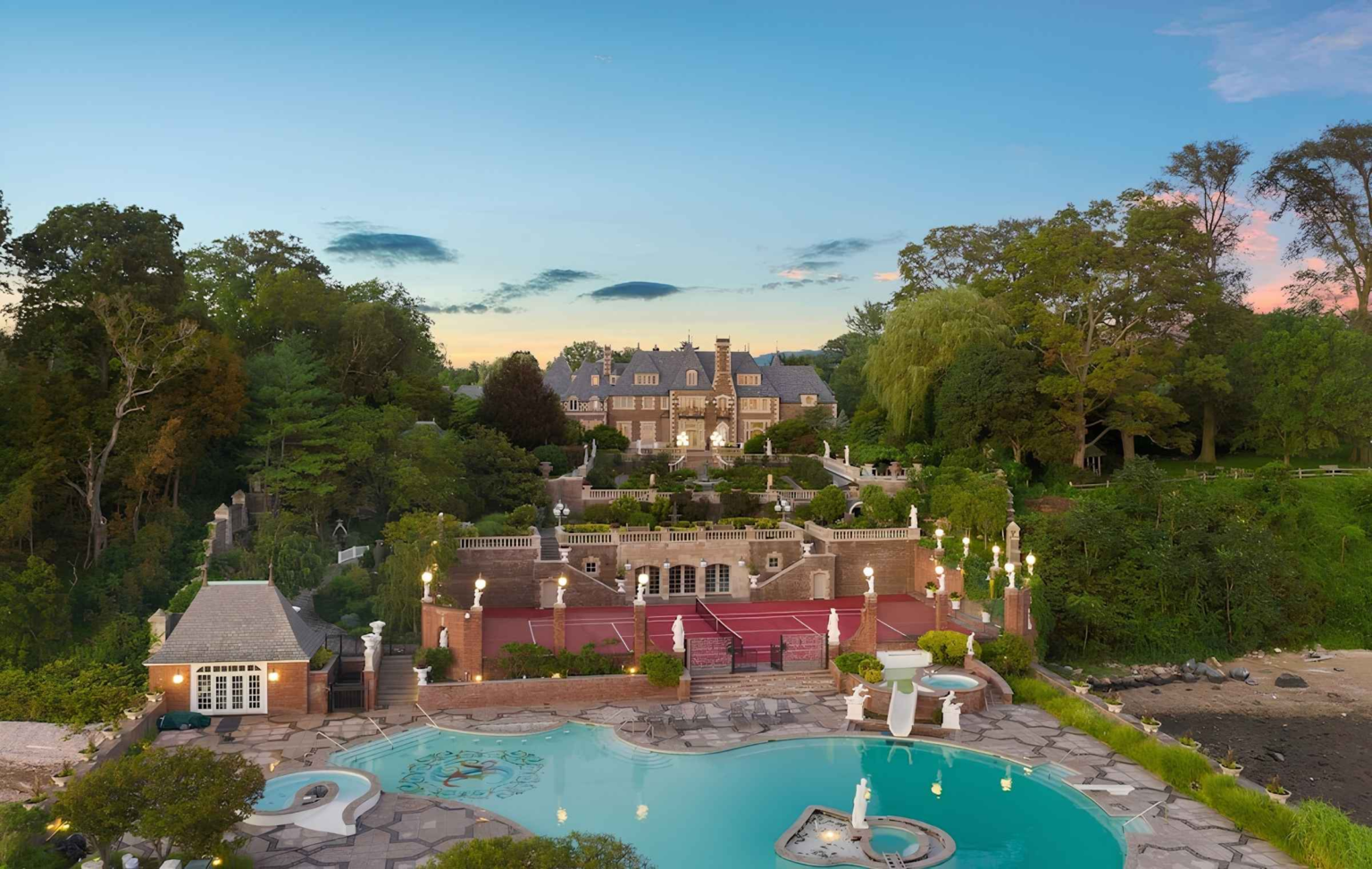
Featured: 26 Pond Road, Kings Point, New York
Every City Has a Version of This
New York is the clearest case because the numbers are so blunt, but the shape is not local to it.
A court is the same size everywhere. Land is not. So in every market we cover, the private court sits at some distance from the centre, and how far out depends entirely on how the land around that city was drawn and when. Cities that grew before the car left long garden plots. Cities that grew after did not. A court fits in the first and rarely in the second.
What the Court Tells You Here
In most markets a private court signals taste, or discipline, or how seriously a household takes the game. Around New York it also measures distance. It tells you how far out the family was willing to go to get one.
If you are looking for a court within reach of the city, the search starts on the North Shore and works outward.