

July 23, 2026
Landmaxxing is the year’s dominant move in luxury real estate. We want to read it through something the coverage leaves out: the tennis court, and the land it demands.
Landmaxxing, read through the court.
The wealthiest buyers in America have changed what they shop for. Not the largest house. The land around it. The move has a name now, landmaxxing, and Coldwell Banker’s 2026 mid-year luxury report placed it first among the trends shaping the market. Buyers acquire the property next door, sometimes the one after that, and combine them into a single private compound.
Most of the coverage stays on the prices and the names. We are interested in a quieter question. Once the extra land is yours, what goes on it? The reporting we reviewed lists staff housing, gardens, garages, and docks. It does not mention a tennis court. That absence is the reason we wanted to write this.
The court belongs on that list, and the reason is not sentiment. It is dimensions. A real tennis court needs more flat, uninterrupted ground than almost any other private amenity. That single fact, which is not in dispute, is worth holding onto as landmaxxing spreads. What follows is our reading of it, not a claim about why any particular buyer bought what they bought.
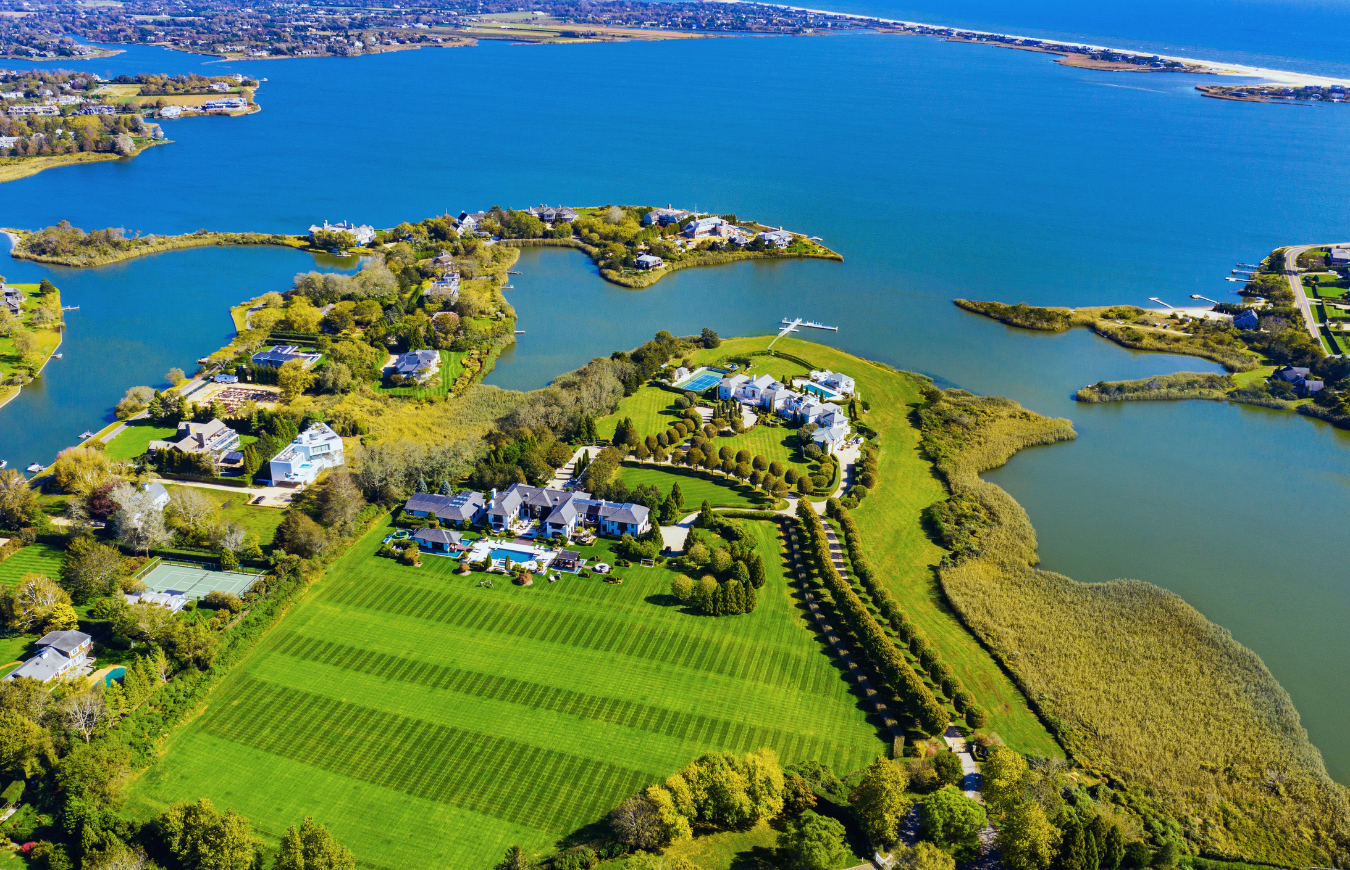
Featured: Mecox Bay Estate | Hedgerow Exclusive Properties
Land Became the Trophy
Coldwell Banker found that United States luxury-property searches doubled over the first five months of 2026 against the same period a year earlier. Searches for buildable land rose 97 percent. The hunt for one-of-a-kind properties, private islands, historic homes, and estates, grew fastest of all, up 146 percent.
The logic is not vanity, even where it looks like it. A house can be renovated or torn down. The lot beside it cannot be manufactured. Combine several neighboring parcels and the result is close to impossible to recreate, which is where the value settles. The cost is flexibility. What makes an assembled compound hard to replace also makes it hard to sell, because the same scarcity narrows the field of buyers who could take it on. For an owner using land as a long hold, that is a feature rather than a flaw.
The clearest examples sit in South Florida, in and around the market we follow most closely. Ken Griffin has spent more than a decade and over $450 million assembling roughly 27 acres in Palm Beach. In Manalapan, WeatherTech founder David MacNeil has bought the lot next door more than once, pushing his compound past $136 million, and split a four-acre parcel with Oracle’s Larry Ellison. In Miami, Jeff Bezos spent north of $230 million on homes along Indian Creek.
Brokers quoted on the trend describe the same motive in different words. Speaking to the Wall Street Journal, Coldwell Banker’s Danny Hertzberg framed it as privacy and security, and for some buyers a safe place to hold money. In The Real Deal, Douglas Elliman’s Nick Malinosky noted that the numbers can look astronomical from outside, but for the buyer they read as protecting an investment. Also in the Journal, Margit Brandt of Premier Estate Properties, who represented MacNeil in Manalapan, put the economics plainly: the value does not live in any single parcel. It lives in the configuration, the assembled whole that is “almost impossible to recreate.”
How Much Land a Tennis Court Needs
Here is what the trend coverage has no reason to mention, and what we think about constantly.
A tennis court is one of the largest flat, contiguous, single-purpose spaces a private residence can hold. The playing lines of a doubles court run 78 feet by 36 feet. That is the number people picture, and it is not the one that matters. The International Tennis Federation recommends 21 feet of run-back behind each baseline and 12 feet beside each sideline, so a court built for real play needs a clear rectangle of about 120 feet by 60 feet. Call it 7,200 square feet of level ground, before fencing, before a viewing area, before landscaping.
Placement adds another constraint. A court plays best oriented north to south, so the low morning and evening sun sits off the sideline instead of in a server’s eyes. The court wants a specific rectangle, at a specific angle, on ground that is level. A property does not always have one to give.
On a large inland estate, none of this is a problem. On a narrow waterfront lot, shaped by setbacks, a seawall, the pool, and the house itself, it often is. This is where our reading of landmaxxing begins. When a real court cannot fit the ground already owned, the parcel next door stops being surplus. It becomes, potentially, the only place the court could go.
Of the amenities that could justify absorbing the lot next door, a regulation court is one of the few that genuinely needs that much room. Where the court is the point of a property, the size of the parcel stops being a detail.
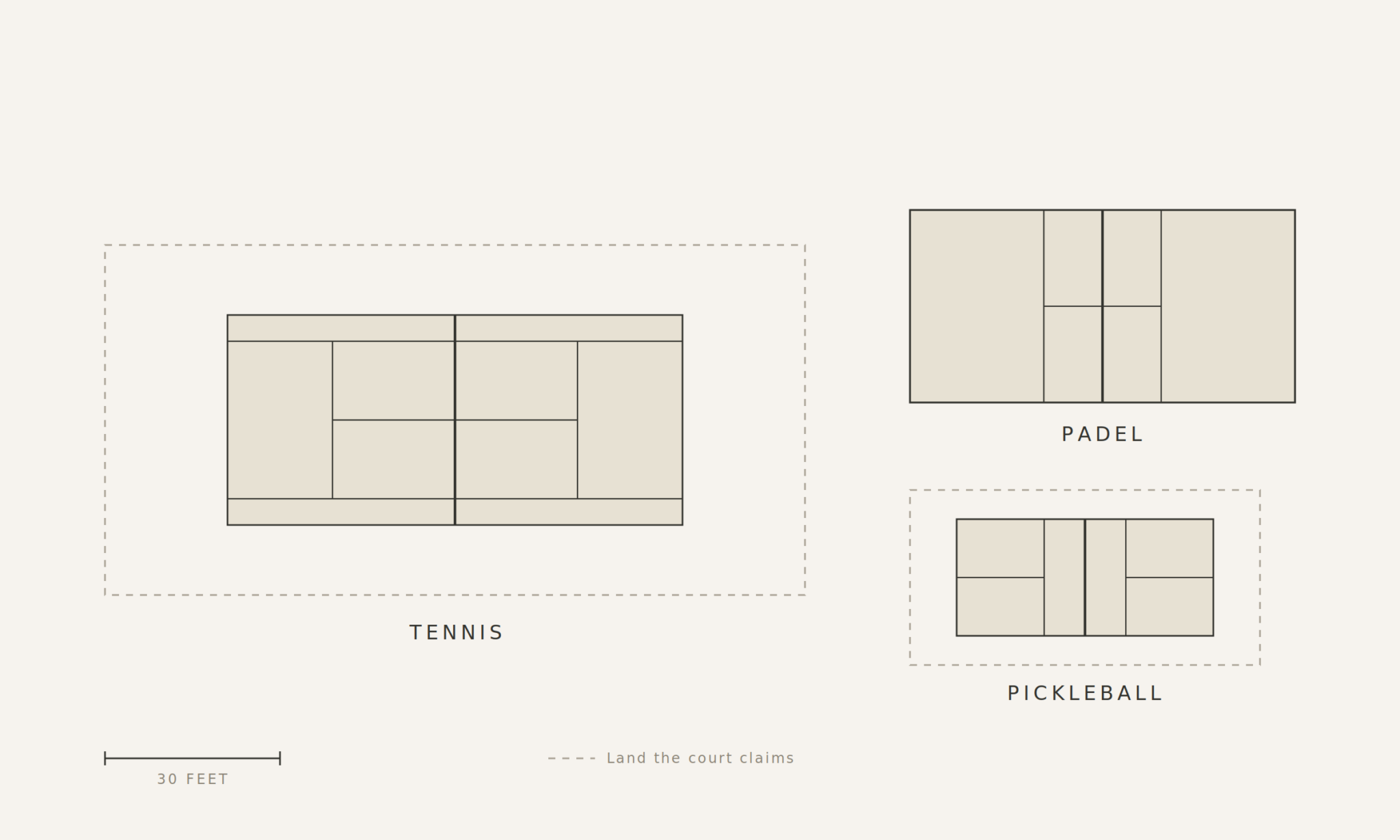
The same three courts, drawn to scale. Footprint is the whole difference.
Padel and Pickleball Change the Math
The full tennis court is the land-hungry option. The two racquet sports growing around it are not, and that gap is worth understanding on any property with land to spare.
A padel court plays inside glass and mesh walls on a surface of 66 feet by 33 feet. Because the walls form the boundary, it needs almost no run-off, roughly half a meter of clearance, so the whole footprint lands near 2,500 square feet and can sit tight against a wall or a property line. A pickleball court is smaller again: a 20 by 44 foot playing area that fits, with its surrounds, in about 1,800 square feet. Either can slot into a corner of a property where a regulation tennis court never could.
So the same land offers different answers. A full court needs the one open expanse large enough to hold it. Padel and pickleball can take the leftover geometry: the side yard, the flat run near the water, the ground behind a guest house. They do not replace a tennis court, and they do not replace each other. Where there is room, they can sit alongside it. We wrote about padel’s rise on its own terms earlier this year. Landmaxxing is simply the setting where the space to consider all three actually exists.
Reading the Land When the Court Is the Point
If tennis is central to how a home will be used, we would start with the land. Not where a court could be painted, but whether the ground, or the ground plus the lot beside it, can hold a real one.
The court was never just a court. It is a claim on land, and land is what this market wants most. If you are looking for a home where the court had the room to be done properly, or you own one and want it understood by the people who value that, we would like to hear from you.
Until the next match,
Tennis Homes