

July 8, 2026
Tennis was born on grass. Clay grew out of it. The surface that started everything is now the one fewest owners keep.
How it started
The modern game began on a lawn. In 1874, Major Walter Clopton Wingfield patented a portable outdoor version of tennis, and the first Wimbledon Championships were played on grass in 1877. Before clay and hard courts, there was lawn tennis.
Grass was not chosen because it was the most practical surface. It was chosen because it was already there. Country houses had lawns. Croquet clubs had lawns. Tennis moved onto them naturally, and the early shape of the game grew from that setting: fast points, low bounces, short volleys, and a certain restraint.
That origin still matters. A private grass tennis court carries the oldest associations in the sport: country houses, summer play, white clothing, and a surface that feels closer to a garden than a built court.
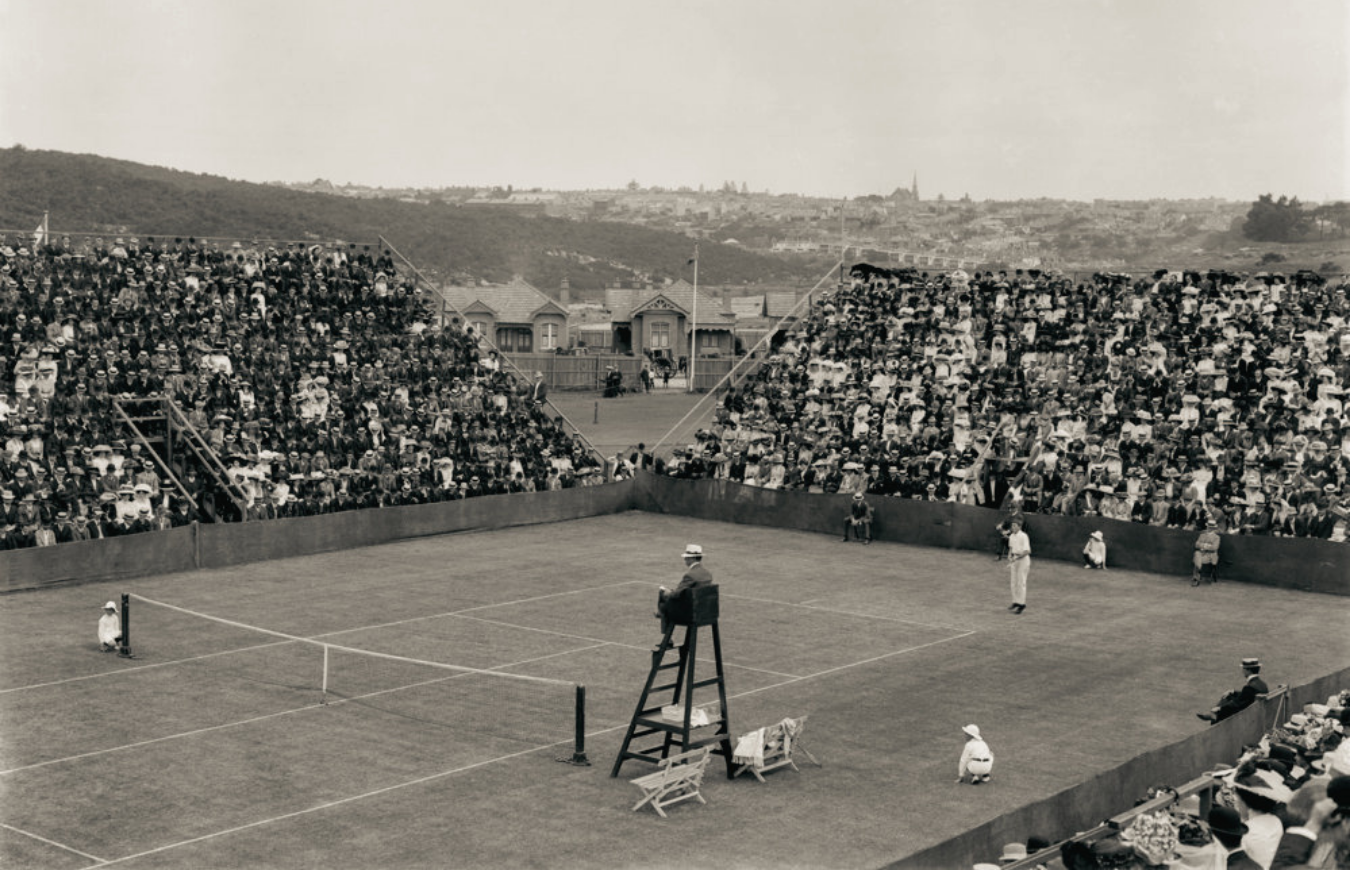
Image credit: City of Sydney Archives, International Lawn Tennis Challenge in Double Bay Grounds Sydney, 1909, Unique ID A-01153306. Photograph / glass negative, photographer unknown.
Clay grew out of grass
Clay did not arrive as a rival to grass. It came from grass.
One of tennis history’s most repeated origin stories places the birth of clay on the French Riviera, where early players looked for a way to keep lawn tennis playable in warmer, drier conditions. A fine layer of crushed terracotta was used to protect the grass beneath, and what began as a practical solution eventually became one of the most important surfaces in the game.
That is why grass and clay are more connected than they seem. Grass is the origin. Clay is the adaptation. One came from the other, and both still belong naturally to the private estate world.
Why private grass tennis courts are so rare
A clay court can be watered, brushed, rolled, patched, and rebuilt season after season. A hard court can sit through months of use with relatively little daily attention. Grass is different. It grows, tires, scars, recovers, and changes with the weather.
A true grass tennis court needs mowing, rolling, watering, reseeding, resting, and expert care. Heavy use wears the baseline first, exactly where the game happens most. In many climates, the best playing window is short, and the court needs time to recover between periods of play.
That is the real reason so few private grass courts remain. It is not that grass lost its appeal. It is that most homes are not set up to maintain a living playing surface with the attention of a grounds team.
Grass is rare because it is alive.
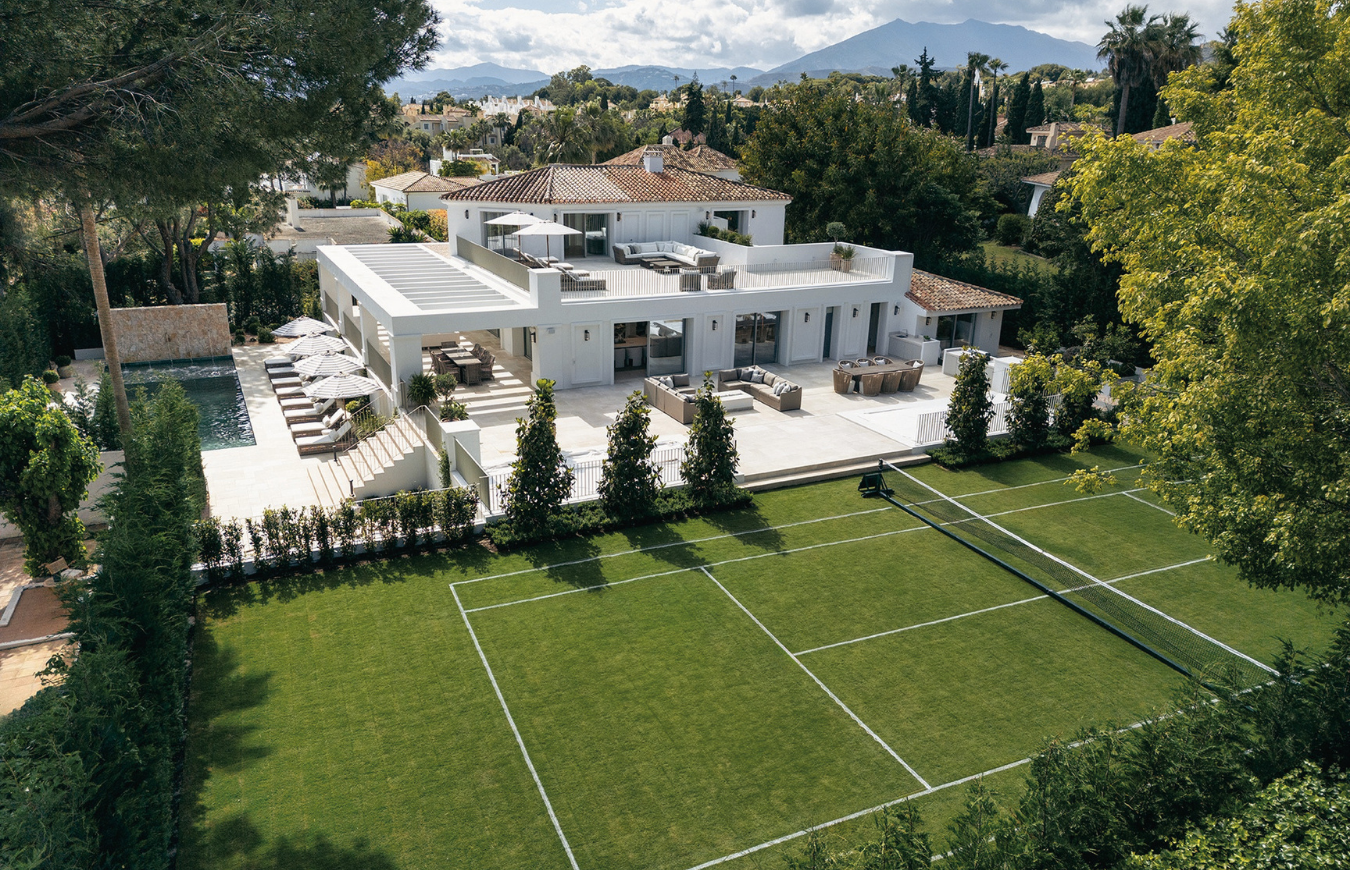
Featured: Grass Tennis Villa Marbella | Super Prime International, Nest Seekers.
A surface with a season
A private grass tennis court is closer to a putting green than a typical backyard court. It has a rhythm. It has a season. It has limits.
That is also what makes it special. A grass court cannot be treated as an all-purpose sports surface. It rewards owners who understand its pace: when to play, when to rest it, when to repair it, and when to let it come back.
This is why grass has almost disappeared from private residential tennis. When it survives, it usually does so in one of three forms.
The three lives of a grass court
A private grass court rarely arrives as a simple purchase. It tends to take one of three forms.
The one still kept.
The one repurposed.
The one waiting to return.
Grass Tennis Villa Marbella is the rare case of grass built new and maintained on purpose. On Marbella’s Golden Mile, minutes from Marbella Club, it is one of the only homes in the area with a full-size private grass court, set against the La Concha mountain and paired with a wellness wing built for recovery.
It sold earlier this year at just under €9 million.
Represented by Thomas Warzywoda, Super Prime International, Nest Seekers.
Country Tennis Estate in Brimfield, Massachusetts, shows what often happens with time. The 60 acre property, known locally as Glen Manor, holds two courts: a clay court, and a grass court now repurposed for events. That detail is the whole lesson in miniature. The grass found a second life as an events lawn, while the clay court stayed in play, the two surfaces sharing one estate the way they have shared the game’s history.
Offered at just under $3 million.
Represented by Annie Youssoufian, Boston Brownstones Realty.
The Hitchcock Estate in Millbrook, New York, is the revival case. Across 2,078 acres held largely intact since 1889, the original tennis court once sat directly in front of the estate’s fountain. The court is gone, but the ground is open and the footprint still reads. For a buyer with the will, it is a chance to bring a lost court back where it began rather than carve a new one from nothing.
Offered at $65 million.
Represented by Heather Croner, William Pitt Sotheby’s International Realty.
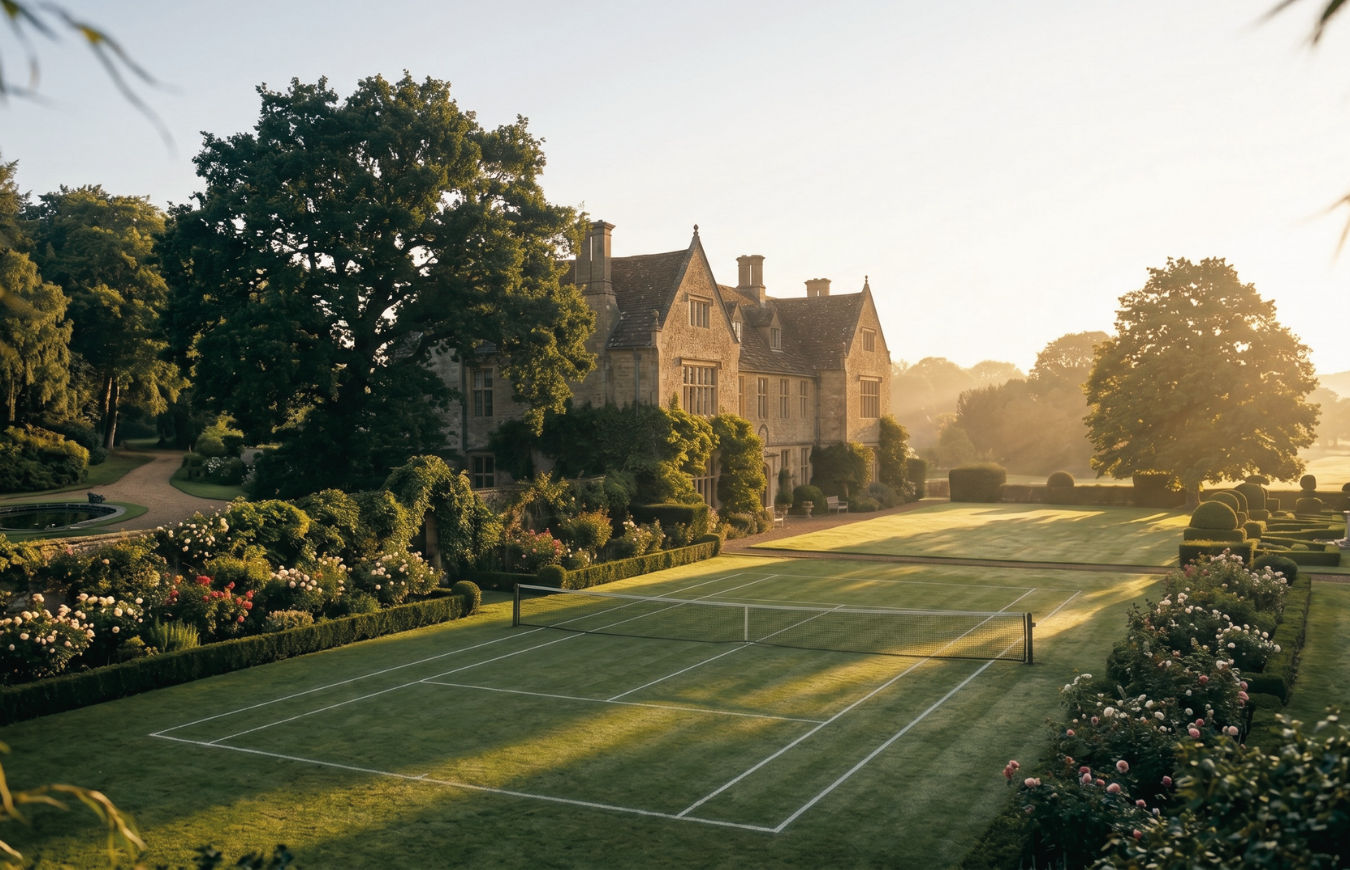
AI-generated concept image, created for visual inspiration only.
Why this matters for buyers and owners
For anyone buying a home with a grass tennis court, the surface is only part of the decision. The real question is the commitment behind it.
A grass court requires the right climate, the right maintenance, and the right expectations around use. It is not the easiest surface to own. It is not the most practical. But for the right estate, it may be the most evocative.
For owners, that rarity can become part of the property’s identity. A private grass tennis court is not simply another amenity. It signals history, care, space, and a particular way of living with the game.
The surface that started it all
Grass is rare because it asks for more. It needs a season, a groundskeeper’s eye, and an owner willing to treat the court as a living surface.
That is why so few remain. And that is also why the ones that do remain matter. They are not just private tennis courts. They are the closest thing residential tennis has to its origin.
Until the next match,
Tennis Homes